zamenhof?! quem é esse cara?

Zamenhof?! Quem é esse cara?

1. Quando eu era menino, como todo bom brasileiro, acho, aprendi a língua do Pê. A gente falava com amigos, acreditando que ninguém entendia. Pra quem nunca ouviu falar disso, eis a regra: após cada sílaba, repete-se a mesma, substituindo-se cada consoante pela letra P; a palavra dobra de tamanho.
     Exemplo: Topôdospôs ospôs popôlípitipicospôs dopô Brapasilpil sãopão sapafapadospôs.
    Algumas crianças mais metidas diziam que falavam a língua do Tê, do Zê, etc. É só substituir o Pê e está feita a língua. Para mal das crianças metidas, o Pê sempre reinou soberano e as outras línguas eram vassalos de nada.
    Objetivo? Não ser entendido. Exibir habilidades.
    Houve um dia em que descobri que havia um dialeto dentro da língua do Pê. Uma língua mais pobre, um “sermo vulgaris”. Algo como falar “os menino comeu os peixe”. Em vez de repetir a sílaba, falava-se “PÊ” antes dela.
    Exemplo: Pêmuipêtos pêpopêlípêtipêcos pêbrapêsipêleipêros pêssão pêlapêdrões.
    Na adolescência, Angela, irmã mais nova, que estudava num colégio só para moças, o Paulo de Frontin, apareceu com uma outra língua. Essa, sim!, sofisticada. Era como falar grego, latim ou alemão. Era difícil de aprender mas, após alguma prática, era a glória. Eis a regra: as sílabas sofriam acréscimo, conforme sua vogal: áik, ênder, óber, ímis, ufúks (havia variantes). Consoante pós-vogal e til eram falados em separado.
    Exemplo: Nóber Bráik-zímis-éle  náik-óber-til  háik  páik-érre-tímis-dóber-ésse  máik-ésse  quáik-drímis-lháik-ésse.
    Chegamos a conversar nessa língua louca.

2. A humanidade fala mais de seis mil línguas. Alguém resolver que vai inventar uma língua a mais, parece coisa totalmente sem sentido, coisa de doido. Com que objetivo? No entanto, em 1532, Juan Luis Vives, judeu nascido na Espanha (mas que de lá saíu, após a morte de seus parentes, pela Inquisição), amigo de Erasmo de Roterdam e Tomás Morus, e que, como todos os humanistas da época, publicava em latim, escreveu o seguinte: “Seria uma felicidade se houvesse uma língua única, que pudesse ser utilizada por todos os povos… O latim vai desaparecer. Então uma grande confusão dominará todas as ciências e os povos viverão em total isolamento”.
    Na verdade, dizer que o “latim vai desaparecer” é eufemismo. O latim já estava desaparecendo. A filosofia e a ciência eram escritas em latim mas as línguas nacionais já criavam suas literaturas. Pensemos na Divina Comédia de Dante (1307!), nas obras de Gil Vicente, Juan de Encina, nos poemas de Leonardo e Michelangelo (isto, em torno de 1500 e anos seguintes). O Príncipe, de Maquiavel, é de 1513, em italiano (mas traz os títulos, curiosamente, em latim).
    No século XIX houve diversas tentativas de se criar uma língua que substituísse o latim nas publicações científicas e nas relações entre falantes de línguas diferentes. A que mais teve sucesso foi o volapuk. Apesar de ter conseguido três congressos internacionais, o volapuk acabou perdendo o prestígio por causa da sua própria estrutura e rigidez: as palavras eram agrupadas de acordo com categorias e suas variações de gênero, número, tempo verbal, etc. Essa língua, sim, era coisa de louco. Artificialíssima.
    Em 1887 Lázaro Luis Zamenhof lançou as bases do Esperanto.
Continue lendo “zamenhof?! quem é esse cara?”
ardeoj kaj vulturoj… 08

medalhas, agulhas...

8. Medaloj, kudriloj kaj aliaj altvaloraĵoj

    Iam, fosante en la kotaro, mi trovis medalon de Nia Sinjorino. Iu diris al mi por ĝin montri al ajnulo, mi memoras nek nomon nek vizaĝon. Subite, mi staris antaŭ li kaj li montris fibolon plenan je medaloj. Ili estis belegaj. Li simple pendfiksis mian medalon al la fibolo kaj diris ke ĝi apartenas al li, li perdintis ĝin. Kompreneble mi ne kredis sed nenion mi rajtis fari.
El kie venis tiuj medaloj? Kiam iu trovadis medalon, zorgis atenteme sed finfine ĝia destino estis la fibolo de tiu junulo. Li estis granda, famiĝis pro sia kolekto kaj kelkfoje pave montris ilin.
Mi neniam plu trovis medalon, eĉ de malsupera sanktulo. Mi pensadis ke, se tio okazos, mi briligos ĝin kaj kaŝos por ke ĝi ne perdu la valoron kiel unu inter multaj en tiu fibolo.
Same valorajn kiel medalojn, ni havis kelkajn trezoretojn, kiuj estis objekto de zorgego. Tamem, siatempe, ĉio pasis de posedanto al posedanto.
Mi scias ke kelkaj lernantoj havis monon. Estis mistero la apero de mono kaj egala mistero estis la trovado de objektoj ne sendataj de parencoj. Mi duonmemoras, iu grandulo rakontis ke li petis al loĝanto de la urbo, tra truo en la muro, ke li aĉetu cigaredon.
Do. La altvaloraj trezoretoj estis kombiloj, dentobrosoj, fiboloj, ŝnuretoj, pecoj de tuko. La tukoj estis disfadenigitaj por ke oni  uzu la fadenojn en la kudraĵoj. Iam, feliĉulo ekhavis pecon el bantuko kaj li montris al ni ke, tirante la fadenon, ĝi venis kaj venis kaj venis kaj neniam finiĝis. La felpeca ŝtofo proponis longegan fadenon, ŝajnis magio. Vere, estis valorega posedaĵo.
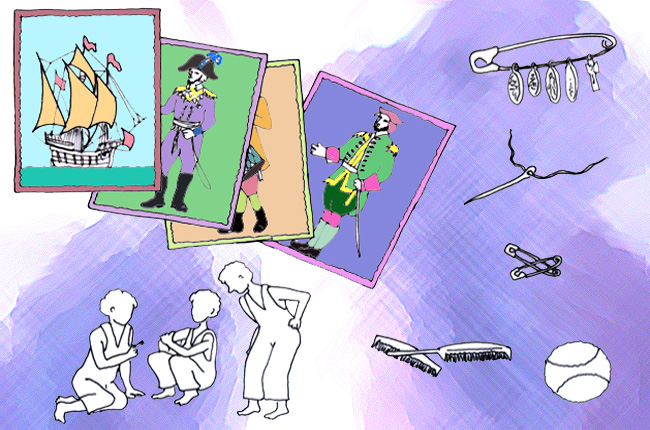
Dum iom da tempo, kelkuloj havis bildoj “Eŭkalol'”. Eŭkalol’ estis marko de tualetsapo. Ene de la pako estis bildo sur dika papero. Kia mirindaĵo! Geraldo alvokis min por ke mi vidu, mi eniris en la grupo de granduloj kaj la posedanto montradis per sia propra mano, neniu rajtis tuŝi ilin. Mi memoras pri velŝipoj, mi memoras pri soldatoj el ĉiuj epokoj, eĉ spadisto! Mirindaĵo, mirindaĵo! Ili aperis en serioj, mi ne memoras detalojn, nur koloroj. Sublimaj koloroj, neforgeseblaj vidataĵoj!
Ni, la etuloj, nenion posedis ĉar la objekto iamaniere malaperadis. Kiam, poste, ni trovis ĝin en mano de iu grandulo, tiom da tempo pasis ke nia rajto nuliĝis. Krom tio ke, se ni plendus, ili batus nin.
Sed kudrilojn ni sukcesis havi. Ho, la kudriloj! Kia pacienco, kia precizeco, kia artfaritaĵo! Jarojn poste mi klopodis por fari unun, por montri al Angela nian laboron. Mi nenion sukcesis.
La plej grava ingredienco, por la farado de kudrilo, estis la tempo. Tion, ni troege havis. Mi faris pli ol unu kudrilon. La drato aperis danke al unu el tiuj mirakloj. Drato enmane, je diversaj dikecoj, post faldo kaj refaldo, ni rompis ĝin je la dezirata mezuro. Tuj poste, ni pintigis ĝin pere de frotado sur glata ŝtono. La dua paŝo estis trovi najleton kaj mi laŭte krias, ho Sinjor’!, Sinjor’!, diru al mi el kie venis tiuj najletoj! Post la ekhavo de la najleto, ni komencis platigi la alian pinton de la kudrilo. Ĝi devus iĝi tre plata. Pro tio ni bezonis specialan ŝtonon, sen reliefaĵo, por ke la metalo ne detruiĝu. Do. Post tio, ni batadis la najleton sur tiu plata kapo. Sur ambaŭ flankoj, alterne. Precize, pacience, trankvile. Tio tordigis la kapeton de la kudrilo kaj denove ni batis sur ĝin per la rondeca ŝtono. Ĝis kiam, finfine, la trueto aperas. Poste, surŝtone, ni fajlis la truitan kapeton por forfini la aspraĵojn.
Estis altvalora juvelo. Ni trafiksis ĝin surkolumen aŭ surpoŝen, mi ne scias, montrante la fragilan ilon.
Mi menciu ankoraŭ la sanktulajn bildetojn, kolorajn vitrajn rompitaĵojn, malplenajn alumetskatolojn, ho!, tiuj estis nemalhaveblaj por la akaparo de lokustoj.
Ili nomis pakaĉon al la donacpako ricevita de parencaro. Mi jam diris ke mi kaj Geraldo ricevis unun. Panjo sendis plie, ni ricevis nur unun. La pakaĉoj plenigis je povo la premiitojn. La petoj ĉiam estis la samaj: kombilo, dentobroso, dentopasto, tualetsapo, parfumo, dolĉa densigita lakto kaj tenisa pilko. La tenisaj pilkoj ravigis min ĉar mi eltrovis ke ili havis du egalajn desegnaĵojn, kiuj adaptiĝis unu ene de la alia, vera miraklo!
Mi memoras ke, iam, iu permesis al mi suĉadon el la trueto de la ladskatoleto kun dolĉa densigita lakto,  Ganimedo neniel ajn proponis la veran ambrozion. Mi ankaŭ memoras ke, iam, grandulo petis al mi fari la manon kiel konkon. Ni partoprenis de spektanta rondo kaj ĉiuj atente rigardadis min, tio estis privilegio inda de imperiestro favorato. Geraldo serioze kontrolis min, la Krezo verŝis en mian manon iom da parfumita harakvo. Ĉirkaŭe ĉio silentis. Mi sciis ke mi devus ŝmiri per ĝi la harojn. Antaŭe, mi intencis senti la parfumon. Sed kiam mi proksimigis la manon al la nazo, kreiĝis tumulteto kaj iu laŭte kriis:
Ne estas trinkaĵo, estas por la haro!
Mi tute skuiĝis pro ektimo, hontoplene, kaj rapide mi malsekigis miajn harojn. Ĉiuj ridis, vantemaj sed ravitaj. Dum longa tempo, pensi pri tiu okazaĵo tre ĉagrenigis min.

daŭrigo en la venonta dimanĉo.

herons and scavengers… 08

medalhas, agulhas...

8. Medals, needles and other valuables

Translated by Angela Telles-Vaz

Once, digging the clay, I found a medal of Our Lady. I was told by so-and-so to tell someone, I don’t remember his name or his face. Suddenly, I stood before him and he showed me a safety pin filled up with medals. I found them beautiful. He simply hung mine and said it belonged to him and he had lost it. Of course I didn’t believe him. There was nothing I could do.
From where did those medals come from? The one who got any would carefully keep it but inevitably they all ended up on his safety pin. He was big, had established the reputation of being the owner of the medals, and at times, showed off the collection.
I never found another one, even of an inferior saint. I thought of scouring and hiding it, to protect it from the depreciation that would bring about that fateful safety pin.
Like the medals, we owned tiny valuable mementoes, kept with an unsurpassed vigor. Even so, the objects passed from owner to owner.
I know that some had money. It was a mystery how the money turned up, similar mystery was the presence of objects that were not sent from some family members as a gift. I remember vaguely of someone older telling that he had asked a kid from the city, through the hole in the wall, to buy him cigarettes.
Well, the valuable mementoes consisted of combs, brushes, safety pins, string and pieces of fabric. The pieces of fabric were shredded for the threads to be used for sewing. Once, a lucky one got a bath towel, a little patch, and kept showing us that by pulling a thread from a plushy fabric, it would keep coming, coming and coming, turning into a long thread. It seemed magical. It was in fact, a valuable possession.
During one period, some had prints of the Eucalol soap. Inside the soap package there were pictures done on thick paper. What a wonderful thing! Geraldo would call me to see, I would join the older group and the owner of the pictures, would exhibit them in his own hand and no one had the right to touch them. I remember sail boats, soldiers of all periods, and there were even swordsmen! Wonderful, wonderful! They came in sets. I don’t remember the details, only the colors, unforgettable visions.
We, the small ones, never possessed anything because the object would end up by disappearing. Later, when it would to be found in the hands of a bigger one it was too late, it was so long ago that the right to claim it had already waned. If you complained, you too would be kicked in the ass.
All we could have were the needles. Ah, the needles! What patience, precision and craft! Later, I tried to make one to show Angela how they were made, when we were already living in Vila Isabel; I could only prove my clumsiness.
The major thing for the manufacturing of the needle was time. We had plenty of time. I made more than one needle. The wire appeared by one of those miracles. The wire of a variable thickness, after bending and re-bending it was cut down to size. Then its edge was sharpened with a flat stone. The next step was to find a little nail and I cry, Lord! Lord! tell me where did those little nails come from! Once the little nail was gotten, it was time to smash the other tip of the needle. It had to be pretty flat. The stone had to be a special one with no sharp end in order to not destroy the metal. Well. After been smashed, a light beat was done using the little nail on the flat tip. It was turned around and the same was done on the other side. Thus, the little nail was lightly bitten on one side and the other using accuracy, patience and calm. Usually, the head of the needle bent over and it was necessary to beat again with the cobblestone. Until, ultimately, the little eye appeared. Then I just smoothed the head of the needle on a stone in order to take the roughness out.
It was a precious jewel. We pinned it on the overall strap or front, displaying the fragile little weapon.
There were still little paper saints, pieces of colored glasses, empty match boxes, ah! all of this was essential for the locust collection.
The gifts sent by some parents were called trinkets. I said that we got one only once. My mother sent us several but we got only one. The trinkets filled with power the one awarded with the shipment. The requests were the same: comb, brush, toothpaste, soap, perfume, condensed milk and tennis ball. The tennis balls delighted me because they had two identical designs that could fit inside another, it was a miracle!
I remember that once, someone let me suck through the hole made on a can of condensed milk, Ganymede never served the true ambrosia. I also remember that an older one asked me to cup my hand. We were in a circle of contemplators and they all looked carefully at me, it was a privilege worthy of the emperor’s favorite. Geraldo watched seriously, Croesus poured a little hair lotion in my hand. Silence surrounded us. I knew it was to be used on the hair. First I wanted to smell it. However, when the hand got close to the nose, a frenzy in unison cheered and someone shouted out loud:
Not for drinking, it’s to be put on the hair!
Frightened, I trembled all over, full of shame, and wet my hair quickly with the stuff. Everyone laughed, jealous but thrilled. I hated to remember the event for a long time.

to be continued on next sunday.