herons and scavengers… 07

overalls

7. Overalls and barefoot on the ground

Translated by Angela Telles-Vaz

I don’t know if my memory betrays me, I didn’t have more than two overalls during that whole period. No, no, now I remember, they were exchanged and were washed. It seems more that they belonged to nobody. After the shower, I think once a week, you got a load of cloth and dressed in it. Sometimes short, sometimes tight, or huge as to fit an astronaut. Sometimes, we exchanged clothes with somebody else. One could hardly breathe with the clothes unbuttoned while the other waltzed inside the huge bag of cloth around him. A rapid exchange would take place and, simultaneously, comfort and looks was established.
Some overalls were full of dark strips that were in fact, defects done by ourselves when threads were needed for our daily sewing.
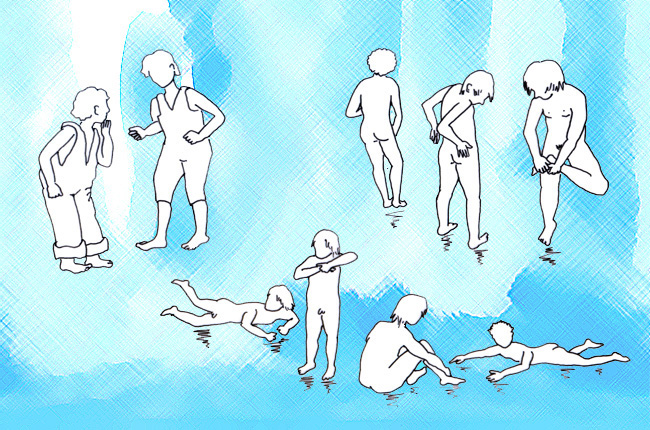
I spoke about showers and forgot a detail nice to remember. We were all naked and the floor was huge, smooth cement and the showers surrounding the entirely wet area. We dived into the ground, sliding a few meters. We stumped on the floor, knocked people down, it was a crazy traffic. Occasionally, a small body was wet was slipping on the cement. We found out that only us the little ones, did this and we found out that in diagonal the path was longer, the body slid further. We dived facing down, imitating the gestures of swimming strokes.
On the opposite, Winter showers were painful. One would go under the icy water, slipped out, but the supervisor would send us back, scrutinizing the torture of one by one.
I was, like many others, seven-eight years old, a little more a little less.
What do I remember more about the overalls? There was a day, when we were in line, we were given a notice that henceforth, all the overalls would have a mark, they would not change owners. My new one was blue and new, of a wonderful blue. I embroidered my initials somewhere. There were children that beautifully embroidered, perfect and neat letters. Others tacked something that looked like a letter but that with only a tweak everything would disappear. Mine was an average one.
The glory of having new overalls lasted for one week. During the next shower, returning to the line, mine wasn’t there. I tried to no avail. I grabbed what was left, one faded, full of missing threads that someone might have used to sew many bags. Much later, I found out that someone was using one with my initials. One of the friends noticed my name and called me, we surrounded the little thief and he then apologized, saying that he had it put on during that week because someone took his own away. Maybe it wasn’t really him. It was useless to exchange them any longer. The fabric was no longer that blue, there were for sure strips of thread taken for the sewing and the embroidery needed.
Throughout that whole time, I didn’t put a pair of shoes on. I remember that someone slipped a pair of black shoes into my feet, after I returned to Rio, I felt excruciating pain.
In fact, I’m not sure if during that whole time I was barefoot. I think I was. Perhaps clogs, I want to remember the clogs but I can’t. No, no, there were no clogs. Going to the stream I remember that we picked dust off the ground with our feet and were scolded by the older ones.
What’s the interest in remembering if we were barefoot or not during the whole time? It’s just an episode that reminds me of being barefoot.
We are lined up to go to the dorms. A black man that I insist on calling Moisés, puzzling everything and mingling it with a black Moisés who protected me, a black man began to shout at his companions, looking at me and some of my friends.
Them sour white people! White but them looks are like a pig! They ain’t washing them foot when they goes to bed. Then they criticizes we black people. I’m black but I sure wash my foot everyday. Them sour milky…
Embarrassed, we removed the dirt stuck from our feet on the drinking water taps.
The memory of the event, created in me the notion that before going upstairs we washed our feet. It was true that after the washing we climbed up barefoot. Dirt clung again to the sole but the top was clean.
I ask: what could have been the minimum temperature that we bared during the two Winters I spend there?
Underwear, t-shirts, sleepers, bath or face towels, sheet, pillows, in some occasions, a blanket, what distant and unattainable luxuries! Only for Little Marcos, who had tuberculosis disease. Only for myself, on a unique redeeming night, when I will sleep at Dona Leca’s house.
Sometimes, we received toothpaste and soap from our relatives. As a matter of fact, I have received it only once, but people claimed doing some shipments. I remember the new toothpaste been eaten carefully, the scented bath soap and the toothbrush that I hung around my neck not to be stolen. After a while, it got rotten with the smell of urine, I guess the string was too long.

to be continued on next sunday.
herons and scavengers… 06

la manĝo

6. The food

Translated by Angela Telles-Vaz
Proofread by Izabel Arocha

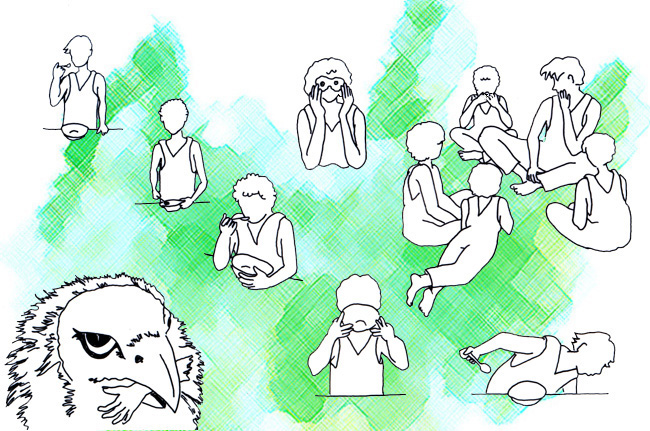
After we left the nightmare, Geraldo always said with a smile that the food was rice and beans for lunch and beans and rice for dinner. It was easy to laugh later. But he didn’t lie.
In the morning we were given a bowl of cornmeal. I have no idea about anything beyond that. How many times the porridge had an unbearable taste of kerosene! It was nauseating at the beginning, horrible later, then strong and finally just a taste of the kerosene. On one occasion, a student said that the general supervisor while visiting the kitchen caught the cook drooling into the porridge pot. I think it was overstated. It was enough the taste of kerosene. I ask now, that taste of kerosene was incompetence or malice? Did it happen by chance or was it a provocation to reduce the capacity of our resistance? For sure it was some kind of an accident. The cook was a little old man, I remember him because of the drooling. Was it because of the memory of the student accusing him that made me think he was an old man?
From Monday to Saturday, we had rice and beans for lunch and dinner. On Sundays we found on the plates (small aluminum bowls, the bowls for the bigger boys were clean and shiny), on Sundays a piece of lamb of the size of a small lime was found. People said that every week a lamb belonging to the priest was slaughtered. Inevitably I suppose, every Sunday there it was, the piece of lamb of the size of a little lime. Would it be possible, by its size, to calculate the number of students? Very complicated!
Some round seeds always emerged in the middle of the rice, disgusting and of an unpalatable taste.
Sometimes, noodle soup was served. Thick noodles loose in water and an unfortunate boy, one of the older ones, shouted he would not eat that because the last time he did it, he found a spider egg inside the thick noodle. How did he know that it was from a spider?, I ask now. It was necessary to cut the noodle with a spoon and look for the egg; if it wasn’t found, it was slowly chewed, frightened of hearing the crack. Luckily the soup was thin and we had it very seldom. And a day came when someone said that the spider egg story was told so we wouldn’t eat the soup that the older would eat.
Well. During a holiday they gave us oranges. Someone shouted, bowls full of oranges would come up, everybody lined up. Each one received his orange and then spread out, peeling it with the teeth, hurting the lips with the acid juice. The peel enabled many games. We did reading glasses and squeezed them on the eyes of the ones unaware. We would make the orange last the longest, it was looked at, licked, chewed with the tongue and the slices finally swallowed with a pity taste. The rest of the day was bright and full of songs. The miracle happened twice during those approximately twenty months. One orange! It was for sure a holy day. Who would be the two miracle saints? It wasn’t and this I do know, it wasn’t the birth of god. No! For that they set apart for us a sweet milk cream and, I kept a bitter and painful chapter about it more at the end.
I also remember the mangoes. I don’t know if many or only a few. I remember only one of them. I have an impression that this fact repeated itself but a really clear scene I only remember one. Someone got a mango. A circle of gazers closed around him and the elected one licked it up with pleasure, slowly, with lips and hands yellow. The smarter one shouted, give it to me when you throw it away, then another one quickly, give it to me when you don’t want it anymore, after to me too, me too, me too and then, a sort of line was made. Tired of enjoying himself alone, the owner of the mango passed the fruit over with the pulp still full of juice and the second priest continued the service, drooling in the middle of mass, while the chief priest stood back to be able to lick his fingers stained with gold. The third boy caught whiter shreds still juicy. It didn’t last him long for the neighbor’s eyes, next in line, stared at such a betrayal. He would hand out the pit shredded which was white and already dried. Was it still juicy? Yes, of course, because the next boy smiled and swallowed deeply his own saliva.
Would my memory have erased some lettuce leaf or a piece of potato? No. I’m positive that I have not eaten anything different while I was there. If the miracle had occurred it would have marked with fire letters on the stone belonging to the bearded man. For, as there are the two oranges and the mangoes, oddly, there are the slices of the raw cassava. We never ate cooked cassava; expressing myself better, I don’t remember we ate cooked cassava. But I do remember that a student, the cook’s assistant, used to take outside pieces of rotten raw cassava. It was of a bright white pulp with little purple veins along the portion. I got these cassavas occasionally. It seems that someone from Geraldo’s class was for a certain time a helper in the kitchen. We ate carefully the white part, nasty sweet, and if by any chance, bit the purple part, we would soon feel the tongue bitter and sour. When the white piece was over, we began to nibble at the parts less rotten, becoming accostumed to the changes of taste. Until finally we ate everything else, either purple or with bad taste, showing a face of disgust.
Aside from that, there was the custom of having bags of food. It’s very hard to explain but I’ll try.
We had needdles. I’ll tell in a while how they were made. For now, let’s just say that we had needles. We sewed some small pieces of cloth (my god! from where did they come from?), using threads unwoven from the overalls and with refinement, a little bag was made. It had a hem and inserted in it a string that fastened the bag and was used as a handle. I never got to do that because the result was disgusting. The bag was hung at the waist, inside the clothes. During meals it was filled with leftovers. And that’s how it was kept until it was time to go to the dorm. The movement done by walking transformed the rice and beans into a brown paste of very strong smell. That’s what they ate when darkness fell. I’m sure that the food, or the bag that kept it, in the jargon of the school, had a special name. I don’t remember the word.
There was a story about it. One of the students had filled the bag too much and after the meal everybody had to march. The dough went to and fro, something huge went in and out between the legs, where the student should not have more than the natural flesh. The supervisor told him to get out of the line, take off his pants and, after all the embarrassment in front of every one, he had to give his hands to be paddled. The paddle was full of little holes to be more hurtful. That paddle will be in use many times.
In ancient Rome, the students were struck with a paddle:
    Non laboras, vapulas.
This was at least, a thousand nine hundred and some more years of our civilization. Civilization…
There’s only one episode yet to be recorded. I talked about the row of faucets where water was drunk from and feet were washed.
In one occasion, there was no water. Something happened and the water stopped running. Who found out that there was water inside the cistern? It was extremely hard to climb up the toilet walls. At first, we still remembered to replace the cover. Then, not anymore. It was enough to climb up the wall with one cupped hand while the other held on to it not to lose balance.
The water was heated by the sun, yellowish, and tasted like rust. Or, it had a rusty smell.
During wartime, this kind of water is probably drunk.

to be continued on next sunday.

garças e abutres… 06

la manĝo

6. A comida

    Geraldo sempre disse, sorrindo, após termos saído do pesadelo, que a comida era arroz com feijão no almoço e feijão com arroz no jantar. Depois, era fácil rir. Mas ele não mentia.
De manhã nos davam um prato de mingau de fubá. Não tenho idéia sobre nada além disto. Quantas vezes o mingau tinha um insuportável gosto de querosene! No começo, nauseante, mais tarde, horrível, depois, forte e, finalmente, apenas um gosto de querosene. Numa feita um aluno falou que o inspetor geral visitara a cozinha e deu com o cozinheiro babando na panela de mingau. Devia ser exagero. Tenho a impressão de que era exagero. Bastava o gosto de querosene. Pergunto agora: aquele gosto de querosene era imperícia ou malícia? Acontecia por acaso, ou era uma provocação para diminuir a capacidade de nossas resistências? Com certeza, houve algum acidente. O cozinheiro era um velhinho, lembro dele por causa dessa baba. Será que foi a lembrança do aluno acusando-o, que me fez imaginar que ele era um velhinho?
De segunda a sábado, no almoço e no jantar, arroz com feijão. No domingo aparecia nos pratos (eram pequenas bacias de alumínio, as dos grandes, limpas e brilhantes), aparecia nos domingos um pedaço de carne de carneiro do tamanho de um pequeno limão. Cada semana matavam um carneiro do padre, falava-se. Todo domingo, acho que inevitavelmente, lá estava o pedaço de carne do tamanho de um limãozinho. Pelo tamanho, daria para calcular o número de alunos? Muito complicado!
No meio do arroz sempre apareciam sementinhas redondas, nojentas e de gosto intragável.
Alguma vez, foi servida sopa de macarrão. Eram macarrões grossos, soltos na água e algum infeliz, um dos grandes, gritou alto que não comia aquilo porque, da última vez, tinha encontrado dentro de um pedaço de macarrão, um ovo de aranha. Como ele sabia que era de aranha?, pergunto, agora. Era preciso, com a colher, cortar o macarrão e procurar o ovo; não achando, mordia-se lentamente, temeroso de ouvir o estalo. Felizmente a sopa era rala e era rara. E veio um dia, em que alguém falou que a história do ovo de aranha era para que a gente não comesse a sopa, que os grandes comeriam.
Bem. Em algum dia de festas nos deram laranjas. Alguém gritava, apareciam bacias cheias de laranja, formava-se a fila. Cada um recebia sua laranja e todos se espalhavam, descascando com os dentes e machucando os lábios com o sumo ácido. As cascas davam muitas brincadeiras, fazíamos óculos, espremíamos nos olhos dos desavisados. Fazíamos com que a laranja durasse o máximo de tempo, ela era contemplada, era lambida, era amassada com a língua e os gomos eram finalmente engolidos, com gosto de dó. O resto do dia era luminoso e cheio de canções. O milagre ocorreu duas vezes, naqueles aproximados vinte meses. Uma laranja! Com certeza era dia santo. Quais teriam sido os dois santos milagreiros? Não foi, disso eu sei, o nascimento do deus. Não! Para esse nos reservaram um doce de leite, pro qual eu reservei um capítulo mais pro final, amargo e doloroso.
Lembro também das mangas. Não sei se muitas, não sei se poucas. Na verdade só lembro de uma. Tenho noção de que este fato se repetira, mas cena nítida mesmo, só me lembro de uma. Alguém ganhou uma manga. Fechou-se em torno dele um círculo de contempladores e o eleito lambia-se de prazer, lentamente, com os lábios e as mãos amarelos. O mais esperto gritou, quando for jogar fora dá pra mim e outro rapidamente e você me dá quando não quiser depois eu depois eu e depois eu e estava feita uma espécie de fila. Cansado de gozar sozinho, o dono da manga passava o fruto com fiapos ainda cheios de suco e o segundo sacerdote continuava o culto, babando-se no centro da missa, enquanto o sacerdote-mor se afastava para lamber longe os seus dedos manchados de ouro. O terceiro já pegava fiapos mais brancos, ainda molhados. Durava pouco para ele, porque os olhos do vizinho, o próximo da fila, se arregalavam diante de tanta traição. Ele passava o caroço esfiapado. Branco e já ressecado. Restaria ainda um caldinho? Certamente que sim, porque o seguinte sorria e sugava fundo a própria saliva.
Teria minha memória apagado alguma folha de alface ou um pedaço de batata? Não. Sei que nunca comi nada diferente enquanto estive lá. Se tivesse ocorrido o prodígio, ele se marcaria como letras de fogo na pedra do barbudo. Porque, assim como há as duas laranjas e as mangas, avulsas, há os pedaços de mandioca. Nunca comemos mandioca cozida; melhor dizendo, não me lembro de termos comido mandioca cozida. Mas me recordo que algum aluno, ajudante do cozinheiro, costumava levar para fora, pedaços estragados de mandioca crua. Era uma polpa branquinha, com pequenos veios roxos, ao longo da porção. Ganhei dessas mandiocas, vez ou outra. Parece que um da turma do Geraldo andou ajudando na cozinha. A gente comia a parte branca, com cuidado, era de um doce desagradável, e se, por acaso, mordia o roxo, sentia logo o amargo e azedo na língua. Quando a carne branca terminava, começava-se a mordiscar os pedaços menos estragados, acostumando-se aos poucos com a mudança de paladar, até que, finalmente, comia-se todo o resto, roxo e de gosto ruim, com cara de nojo.
Afora isto, havia o hábito das sacolas de comida. É muito complicado explicar. Vou tentar.
A gente tinha agulhas. Contarei daqui a pouco como elas eram feitas. Por ora, fica dito que se tinha agulhas. Costurava-se pequenos pedaços de pano (de onde surgiriam? deus meu!), usando-se fios desfiados dos macacões, e se fazia uma pequena sacola. Com requintes. Ela tinha uma bainha e por essa bainha passava-se um barbante que apertava a boca do saquinho e servia de alça. Nunca cheguei a fazer isto, porque o resultado era repugnante. A sacola ficava pendurada na cintura, dentro da roupa. Durante a refeição, era preenchida com sobras de comida. E assim ficava ela, até a hora de ir para o dormitório. Os movimentos do andar, misturavam tudo e transformavam o arroz e o feijão numa pasta marrom, de cheiro muito forte. Era isto que eles comiam quando escurecia. Tenho certeza que esta comida, ou a sacola que a continha, tinha, na gíria do colégio, um nome especial. Não me lembro da palavra.
Havia uma história a respeito disso. Um dos alunos enchera demais a sacola e após a refeição todos foram postos a marchar. O bolo ia e vinha, alguma coisa enorme saía e entrava entre as pernas, onde o aluno não deveria ter mais que as carnes naturais do local. O inspetor mandou-o sair de forma, tirar a calça e, após o vexame diante de todo mundo, teve que apresentar as mãos à palmatória. Aquela palmatória era cheia de furinhos, para doer mais. Ela funcionará muitas  vezes.
Na Roma antiga os alunos apanhavam com palmatória:
    Non laboras, vapulas.
Isto foi, no mínimo, há mil e novecentos e tantos anos da nossa civilização. Civilização…
Não fica, se não, um acontecimento, a registrar ainda. Falei da fila de torneiras onde se bebia água e se lavava os pés.
Houve uma ocasião sem água. Alguma coisa aconteceu e a água deixou de correr. Quem descobriu que as caixas de descarga tinham água? Era dificílimo trepar naquelas paredes dos sanitários. No começo a gente ainda se lembrava de recolocar a tampa. Depois, não mais. Bastava escalar a parede e beber com uma das mãos em concha enquanto com a outra se segurava para não perder o equilíbrio.
Era uma água quente, por causa do sol, amarela e com gosto de ferrugem. Ou, com cheiro de ferrugem.
Na guerra, também se deve beber daquelas águas.

continua no próximo domingo.