garças e abutres… 16

the church

16. A Igreja

    Não devia ser muito grande nem muito rica. Mas forçosamente haveria algum dourado, alguma flor, alguma vela acesa ou luminária pendente de um longo fio, algum vidro colorido, ficava bonito. Tenho a impressão de uma fila de quadrinhos, representando a via sacra, que pinturas maravilhosas! pareciam fotografias! hoje seriam uma vulgar repetição acadêmica no estilo de David, talvez nem tanto.
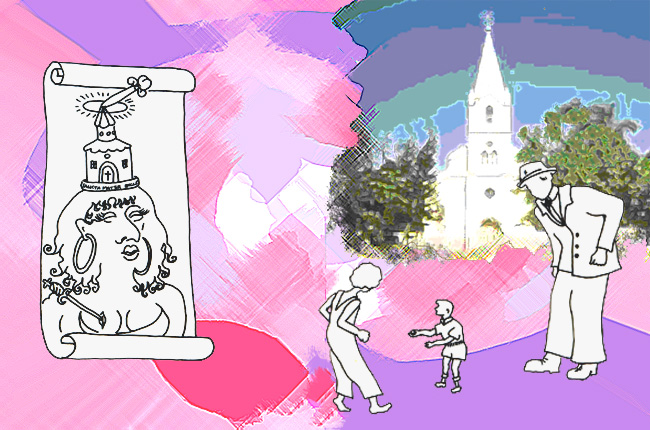
O que mais me impressionava, todavia, era a estátua daquela mulher. Olhos brilhantes, molhados, cabelos de verdade e um punhal enfiado no peito. A carne do seio, do pequeno pedaço de seio que se mostrava, se abria numa chaga como dois lábios virginais, uma mancha de sangue e o punhal imenso. Nossa Senhora das Dores. Ninguém me explicou que aquele punhal era simbólico, entendi como realidade e talvez já tivesse feito a relação com o defloramento.
Aquela imagem me perseguia, a impressão de tê-la diante de mim é nítida demais e dá para avaliar o horror que me inspirava. Isto foi em 1949 e 1950. Em 1961, onze anos depois, sonhei com aquela estátua. Nua da cintura para cima, tendo no colo o Cristo morto, um tanto ou quanto na posição da Pietá de Michelangelo. Não havia punhal, mas os dois seios se apresentavam cortados horizontalmente. Em 1973, o sonho mudou. A mulher tem uma criança no colo, à semelhança das madonas de Rafael. Nua como a anterior, mas aqui é um quadro. Parado próximo à tela, a estátua muito bela de um sacerdote egípcio com um punhal na mão. A estátua avança para o quadro, eu esboço uma tentativa de impedimento, mas prefiro me deixar assistindo para ver o que vai acontecer. Ele perfura o seio da figura e escorre um filete de sangue vermelho.
Aquela igreja, como todas as outras, até durante algum tempo, me inspirava mais terror do que qualquer outra emoção. Os santos, vestidos de vermelho e com cabelos de gente, me semelhavam cadáveres ressurrectos, ainda verdes, ainda sem movimento. Mas o mais terrível eram aqueles olhos de verdade, brilhantes e penetrantes, olhando para um ponto à sua frente, parados, inflexíveis, ao mesmo tempo eternamente vivos e eternamente mortos.
Sentávamo-nos num banco comprido, balançando os pés empoeirados. Eu vigiava o ambiente, imitando o levantar-se, o ajoelhar-se, o sentar-se. Eu vigiava.
Acho que não íamos muito à igreja; felizmente, para meus sonhos. Desses passeios pesados, não tenho senão duas lembranças. Muito amargas, dois abutres lúgubres que vêm e vão eternamente dentro de mim. Param, me olham um tempo, estremecem e continuam o ir e vir. Teriam estes dois fatos acontecido no mesmo domingo? Tanto faz. A esta altura, tanto faz.
Íamos à missa comum, nenhuma era especialmente rezada para os alunos. Sentávamo-nos mais ou menos amontoados sobre alguns bancos e a cidade ocupava o resto.
Era Ele quem oficiava.
Que diferença faz?, se também existem as missas negras.
Descobri que o menininho da frente comia uma cocada. Estava com o pai, um homem que deixara a seu lado, sobre o banco, um chapéu. Existem, pois, encarcerados eternamente dentro de mim, numa célula-cela da memória, um pai que tem chapéu e um menino que come cocada. Ele comia devagar, pedacinho por pedacinho e a demora era angustiante. Desapareceu tudo ao redor e só passou a haver no universo um pedaço de doce que subia, descia, se escondia, voltava. Branco, irregular, esfarelante. Se ele a tivesse comido numa engolida, limpando as mãozinhas meladas nas calças, a cocada talvez já estivesse apagada dentro de mim e ele também e o pai, com mais motivo ainda. Mas não foi o que aconteceu. Ele, involuntariamente, prosseguia na tortura. Não sabia da salivação aflita. Não sabia da respiração suspensa. Não sabia da vigilância tão próxima.
O menino calçava sapatos e sua roupa era limpinha.
Aqui, minha fantasia me ilude, confunde a consumação do episódio. Ora eu vejo o menino sair com o pai, deixando no banco um pedaço de doce, que eu como. Ora eu vejo, na saída, o homem aproximar-se de mim com um doce na mão, presenteando-me.
Qual. Não deve ter sido nada disto. Quando Ele nos liberou, todos se levantaram, eu tive de sair no meio do tumulto e perdi a visão.
Mas minha fantasia insiste e me mostra também uns farelinhos de coco espalhados sobre o banco, esquecidos.

A outra lembrança, é a do dia da confissão. Estávamos maravilhosamente preparados. As professoras tinham contado de pessoas que não confessavam todos os seus pecados e as hóstias sangravam ou eram vomitadas com insuportável fedor. A mais estranha era a da menininha
inocente como ele
que queria comungar e não deixaram porque ela era pequena demais e na hora da comunhão a hóstia se desgarrou dos dedos do padre, voou pelo templo e pousou sobre a cabeça do pequenino anjo. Como um espírito santo.
Estávamos maravilhosamente preparados. Preferia que o chão se abrisse e que eu desaparecesse. Tinha horror em pensar que eu poderia esquecer algum pecado, eram tão complicados aqueles pecados…
os pecados mortais são tantos
os pecados capitais são tantos
os pecados veniais são tantos
e havia aquela eumênide silenciosa e grudada na minha alma, a quem chamavam pecado original.
Eu estava maravilhosamente preparado.
Veio a minha vez e eu tropecei até chegar lá. Gaguejei as primeiras palavras e, num relance, enumerei meus horrores
arrancar a cabeça dos grilos
brigar com os amiguinhos
fazer maldades.
Que maldade?
Batia num menino aleijado.
Só?
Rasgava as figurinhas dele, zangava com ele, xingava ele.
O que mais?
Aquela voz me encarcerava. Da voz eu me lembro. Era macia, meio rouca, mas não tinha dono. Era uma voz demoníaca que saía de trás das grades, eu dialogava com a grade.
Eu silenciei e ele perguntou novamente o que mais. O que mais ele queria? Algum pecado mortal? Que eu desonrasse pai e mãe? Que eu cobiçasse a mulher do Próximo?, aquele sujeito desconhecido e de nome tão engraçado!
Eu bato nele, estrago os brinquedos dele.
A grade se calou, mas não me despediu. Comecei a suar frio. O silêncio estava exigindo que eu continuasse, eu precisava de mais pecados!
Matei passarinhos! (Nunca tinha matado passarinhos!)
Xinguei a professora!
Ele continuou calado.
Depois…
Que coisas feias você pensa?
Eu perguntaria a ele hoje, que coisas feias pensa uma criança de sete-oito anos. Filho da puta! Terrorista! Filho da puta!
Terrorista filho da puta!

Os antigos gostavam muito de alegorias. Pintaram a Inocência, a Cólera… Botticelli tem uma Calúnia. Dürer tem uma muito expressiva Melancolia. Alguém teria pintado ou esculpido a Sancta Mater Igreja? Seria essa alegoria como aquela mulher das dores, com o seio-hímem, da forma mais sadomasoquista possível, trespassado por um punhal fálico?
Tento imaginar a alegoria que existiria na cabeça de um menino de 7-8 anos, em função de sua experiência num internato dirigido por um padre. Lembro do filme Roma, de Fellini. No meio da neblina surge uma puta. É uma enorme mulher, se veste de preto. Exibe as mamas imensas, que poderiam ser a redenção para todos os bebês famintos do mundo. Antes de desaparecer de cena, limpa as gengivas com a língua, numa careta… Não! Uma puta pobre? Basta pensar nos tesouros do Vaticano.
Há uma outra, mais ao final do filme. Esta, num bordel de luxo… Não, é melhor abandonar estas imagens, esta, de rosto belíssimo, e a outra, tão humana…
Prefiro imaginar uma bruxa com o seio perfurado, eis que aqui ela encarna a Grande Meretriz do Apocalipse. A que se acha sentada por sobre as águas. Com quem se prostituíram os reis da terra. A Igreja.

continua no próximo domingo.

ardeoj kaj vulturoj… 16

the church

16. La preĝejo

la preĝejo

    Certe, ĝi nek estis granda nek tro riĉa. Sed, neeviteble, devus aperi oraĵon, iu floro, iu lumiganta kandelo aŭ per longa ŝnuro pendanta iluminaĵo, iu plenkolora vitraĵo, tiaj aferoj  belas. Ŝajnas al mi ke estis vico da pentraĵetoj, montrante la sanktan vojon, kiaj mirindaj pentraĵoj!, veraj fotoj!, hodiaŭ vulgara akademia stilo laŭ David, eble eĉ ne tio.
    Tio, kio pli forte kortuŝis min en la preĝejo, estis la skulptaĵo de tiu virino. Brilaj okuloj, malsekaj, homaj haroj kaj ponardo enŝovita en la brusto. La mama karno, de la malgranda parto videbla de la mamo, malfermiĝis en fendeto kiel du virgaj lipoj, sanga makulo kaj imensa ponardo. Nia Sinjorino de la Doloroj! Neniu klarigis al mi ke tiu ponardo estis simbola, mi komprenis kiel realaĵo kaj eble eĉ farintus la komparon kun deflorado.
    Tiu bildo persekutadis min, mi ĉiam pensis ke mi ĝin havas antaŭ mi kaj per tio, oni povas taksi la inspiratan hororon. Tio okazis en 1949 kaj 1950.  En 1961, dek unu jarojn poste, mi sonĝis pri tiu statuo. Nuda de supre la talio, kaj sur la genuoj la mortinta Kristo, tre simila al la Pietá de Michelangelo. Ne estis ponardo, sed ambaŭ mamoj montradis horizontalan tranĉon. En 1973, ŝanĝis la sonĝo. La virino havas infanon surbruste, same kiel la madonoj de Rafael. Nuda, kiel la antaŭa, sed ĉi tie estas pentraĵo. Staras proksime al ŝi belega skulptaĵo de egipta sacerdoto kun ponardo enmane. La skulptaĵo avancas al la pentraĵo, mi ekas klopodon por malhellpi sed preferas halti por spekti tion, kio okazos. Li traboras la mamon de la pentraĵo kaj ruĝa sango elfluas.
    Tiu preĝejo, kiel ĉiuj aliaj, dum longa tempo, inspiris al mi pli da teruro ol ia ajn emocio. La sanktuloj, ruĝe vestitaj kaj kun homaj haroj, al mi estis egalaj al resurektintaj kadavroj, ankoraŭ verdaj, ankoraŭ senmovaj. Sed la plej granda teruraĵo estis tiuj ververaj okuloj, brilaj kaj penetremaj, rigardante punkton antaŭ ili, senmovaj, severaj, poreterne vivantaj kaj poreterne mortintaj.
    Ni sidadis sur longa benko kaj balancadis la polvoplenajn piedojn. Mi observadis la circonstancaron, imitante kaj la stariĝon, kaj la surgenuiĝon kaj la sidiĝon. Mi observadis.
    Mi pensas ke ni malmulte iradis al la preĝejo; des pli bone, pro miaj sonĝoj. De tiuj pezaj promenadoj, mi nur havas du rememorojn. Tro amaraj, du funebraj vulturoj, poreterne ili iras kaj venas ene de mi. Ili haltas, rigardas min iun tempon, tremeras kaj daŭras la iron kaj venon. Ĉu tiuj du faktoj okazis en la sama dimanĉo? Ne gravas. En tiu mia nuno, ne gravas.
    Ni iradis al la ordinara meso, ne okazis speciala meso por la lernantoj. Ni amasiĝis sur kelkaj benkoj kaj la urbanaro okupis la ceterajn.
    La meson faris Li.
    Tio ne gravas, ĉar ankaŭ estas nigraj mesoj.
    Mi rimarkis ke la knabeto antaŭ mi manĝadis kokosan sukeraĵon. Li estis ĉe la patro. La viro lasis la ĉapelon flanke de si, sur la benko. Do, ekzistas porĉiame arestitaj ene de mi, en memora ĉelo, patro kun ĉapelo kaj knabo kiu manĝas kokosan sukeraĵon. Li tre malrapide manĝadis, peceton post peceton, kaj la longa daŭro estis afliktiga. Ĉio ĉirkaŭ mi malaperis kaj en la universo nur ekzistis sukeraĵo kiu iris supren, malsupren, malaperetis, revenis… Blanka, senforma, diseriĝante. Se li ĉion manĝintus unuglute, frotante surpantalonen la mielecajn manetojn, eble la sukeraĵo ne plu ekzistus en mi, nek li, nek, precipe, la patro. Sed tio ne okazis. Li, senvole, daŭrigadis la torturon. Li ne sciis pri la aflikta salivado. Li ne sciis pri la interrompita spirado. Li ne sciis pri la tiel proksima atentego.
    Li havis ŝuojn kaj liaj vestoj estis puregaj.
    Kaj nun mia fantazio konfuzas la finiĝon de la epizodo. Jen, la knabo foriras kun la patro kaj lasas surbanke pecon de la sukeraĵo kaj mi manĝas ĝin. Jen, foririnte, mi vidas la proksimiĝantan viron, sukeraĵo enmane, kiun li donacas al mi.
    Ho! Probable, ne tiamaniere finiĝis la afero. Kiam Li liberigis nin, ĉiuj stariĝis, mi foriris meze de la tumulto kaj la vidataĵo tute malaperis.
    Sed mia fantazio insistas kaj montras al mi eretojn de la kokosa sukeraĵo sterniĝintajn surbenke, forgesitajn.

    La alia rememoro estas pri la konfesa tago. La instruistinoj mirinde preparis nin. Ili rakontis pri homoj, kiuj ne konfesis ĉiujn pekojn kaj la hostioj sangis aŭ estis vomataj kun neeltenebla fetoro. La plej stranga rakonto estis tiu, pri la knabineto,
    senkulpa kiel li,
    kiu intencis komuniiĝi sed oni ne malpermesis ĉar ŝi estis tro juna kaj en la horo de la komunio la hostio eskapis el la fingroj de la pastro kaj flugis tra la preĝejo kaj lokiĝis sur la kapo de la eta anĝelo. Kvazaŭ sankta spirito.
    Ja, la instruistinoj mirinde preparis nin. Mi preferus ke la grundo malfermiĝu kaj glutu min. Hororo regis mian penson pri la eblo forgesi iun peko, tiuj malfacilaj pekoj
    la mortomeritaj pekoj estas tiom
    la ĉefpekoj estas tiom
    la venialaj pekoj estas tiom
    kaj estis ankaŭ tiu eŭmenido silenta kaj algluita al mia animo, nomata prapeko.
    Ja mi estis mirinde preta.
    Jen mia vico kaj mi stumblis rekte al la konfisejo. Mi balbutis parolante la unuajn vortojn kaj, rapidege, mi laŭvice prezentis miaj hororaĵojn:
    mi senkapigas la grilojn
    mi disputas kun la amiketoj
    mi faras mavaĵojn.
    Kiajn mavaĵojn?
    Mi batas kriplan knabon.
    Ĉu nur tio?
    Mi disŝiras liajn bildetojn, mi skoldas lin, mi sakras lin.
    Kaj kion plie?
    Tiu voĉo enkarcerigis min. Mi memoras la voĉon. Estis milda, duonraŭka, sed sen posedanto. Demoneca voĉo venanta de malantaŭ la krado, mi dialogadis kun la krado.
    Mi silentis kaj li denove demandis, kion plie? Kion plie li volis? Ĉu ia mortomerita peko? Ĉu ke mi malrespektu mian patron kaj mian patrinon? Ke mi deziru la edzinon de Proksimulo?, tiu nekonata viro de tiel stranga nomo!
    Mi batas lin, mi fuŝas liajn ludaĵojn.
    La krado silentis sed ne maldungis min. Mi malvarme ekŝvitis. La silento postuladis daŭrigon, mi bezonis aliajn pekojn!
    Mi mortigis birdojn! (Tion, mi neniam faris!)
    Mi sakris kontraŭ la instruistinon!
    Li silente daŭris. Kaj…
    Kiajn maldecaĵojn vi pensas?
    Hodiaŭ mi demandus lin, kiajn maldecaĵojn pensas infano sep-ok jaraĝa. Filo-de-putino! Teroristo! Filo-de-putino!
    Filo-de-putina teroristo!
    
    La antikvuloj tre ŝatis Alegoriojn. Ili pentris la Senkulpecon, la Koleron… Botticelli havas sian Kalumnion. Dürer pentris elokventan Melankolion. Ĉu iu pentris aŭ skulptis la Sancta Mater Eklezion? Certe, ĝi estus simila al tiu virino de la doloroj, kun la himeno-mamo, je la plej sado-masoĥisma maniero, trapasita de la falusa ponardo.
    Mi klopodas por imagi alegorion kiu ekzistus en kapo de knabeto 7-8 jaraĝa, sekve de travivaĵoj en internulejo kies direktoro estis pastro. Mi memoras la filmon Roma, de Fellini. Meze de nebulo ekaperas putinon. Estas enorma virino, nigrevestita. Ŝi montras imensajn mamojn sufiĉajn por redempte nutri ĉiujn malsatajn bebojn de la tuta mondo. Antaŭ ol ŝi malaperos el la sceno, purigas la gingivojn perlange, grimacante… Ne! Malriĉa putino? Sufiĉas ke ni pensu pri la Vatikanaj trezoroj.
    Estas alia, proksime de la fina parto de la filmo. Tiu ĉi, en luksa bordelo… Ne, plibone forgesi tiajn imagaĵojn, tiu-ĉi virino je belega vizaĝo, la alia, tiel homa…
    Mi preferas imagi sorĉistinon kun traborita mamo, jen ĉi tie ŝi estas La Granda Malĉastistino de la Apokalipso. Tiu, kiu sidas sur multaj akvoj. Kun kiu la reĝoj de la tero sin malĉastis. La Eklezio.   
 

    daŭrigo en la venonta dimanĉo.

herons and scavengers… 16

the church

16. The church

Translated by Angela Telles-Vaz

It shouldn’t have been very large or very rich. But necessarily there must have been some gold, some flower, some lit candle or lamp hanging from a long wire, some stained glass because it would look nice. I feel that there was a row of small paintings, depicting the Way of the Cross, what wonderful paintings! Today, they would be a vulgar repetition of David academic style, perhaps not so.
However, what impressed me the most was the statue of that woman. With bright eyes, watery, real hair and with a dagger stuck in her chest. The flesh of her breast, the small amount of breast to be seen, an opened wound like two virginal lips, a stain of blood and the huge dagger. It was Our Lady of Sorrows. Nobody explained me that it was a symbolic dagger, I took it as real and perhaps I had already related that to deflowering.
That image haunted me, the impression of having it before my eyes is too vivid and you can evaluate the horror that it brought me. This happened in 1949 and 1950. In 1961, eleven years later, I dreamed of that statue. Naked from the waist up, having the dead Christ on her lap, somewhat in the same position as the Pieta by Michelangelo. There was no dagger, but the two breasts were cut horizontally. In 1973, the dream changed. The woman has a child on her lap, like a Madonna by Raphael. Naked as the previous one, but in this dream it’s a painting. A very beautiful statue of an Egyptian priest holding a dagger stands next to the painting. The statue goes towards the painting and I attempt to stop it but decide to let myself watch to see what is going to happen. It pierces the heart of the figure in the picture and a blood fillet runs.
That church, like all the others, inspired me, for a while, more terror than any other emotion. The saints dressed in red had real hair, looked at me like resurrected corpses, still green, still motionless. But the most terrible were those real, bright and piercing eyes, looking at a point in front of them, standing inflexible and at the same time eternally alive and eternally dead.
We all would sit on a long bench, swinging our dirty feet. I kept watching the environment imitating the standing up, the kneeling down and the sitting down movements. I kept watching.
I don’t think we went to church much; fortunately because of my dreams. I have but two memories of these heavy visits. Very bitter memories, two vultures come and go forever inside of me. They stop, look at me for a while, shudder and continue with the comings and goings. Could these two events have happened during the same Sunday? Whatever. At this point in time, it doesn’t matter.
We went to regular Mass but none was especially prayed for the students. We sat more or less piled up on some benches and the city occupied the rest.
It was He who officiated.
What difference does it make?, if there are also Black Masses.
I found out that the little boy in front of me ate a coconut candy. He was with his father, a man that left a hat next to him on the bench. There are therefore, imprisoned inside me, in a prison cell of the memory, a father who has a hat and a boy who eats coconut candy. He ate slowly, bit by bit, and the delay was agonizing. Everything disappeared around and the only thing that existed in the universe was a piece of candy that kept going up and down, disappearing and reappearing. White, irregular and crumbled. If he had swallowed the whole thing, cleaning his hands on his pants perhaps the coconut candy would be gone from my mind, even with more reason, he and his father too. But it wasn’t what happened. He, unwittingly, went on with the torture, he didn’t know about the excessive salivation. He didn’t know about the panting, He didn’t know about the close surveillance.
He wore shoes and his clothes were clean.
Here my fantasy eludes me, blurs the consummation of the episode. Sometimes I see the boy leaving with his dad, leaving on the bench, a piece of the candy that I eat. Sometimes, at the exit I see, the man approaching me with a candy in his hand, offering it to me.
Which one of the two? There shouldn’t have been any of this. When He released us, we all stood up, I had to leave in the middle of the turmoil and my vision was gone.
But my fantasy insists and also shows me some crumbs of coconut scattered on the bench, forgotten.

The other memory is of the day of confession. We were wonderfully prepared. The teachers had told us that people that didn’t confess all of their sins the consecrated bread would bleed or would be vomited with an unbearable stench. The strangest one was about the little girl,
innocent like him
who wanted to receive communion and wasn’t allowed because she was too small and at the time of the communion, the consecrated bread fell off the priest’s fingers, flew through the temple and landed on the little angel’s head. Like a holy spirit.
We were wonderfully prepared. I would prefer that the ground opened up and I disappeared. I hated to think that I could forget some sin, those sins, they were so complicated…
mortal sins are so many
deadly sins are so many
venial sins are so many
and there was that silent eumenide stuck in my soul, that was called the original sin.
I was wonderfully prepared.
My turn came up and I stumbled until I got there. I stammered the first words and, at a glance, listed my horrors:
to behead the crickets
to fight with my friends
to do evil.
What evil?
I hit a crippled boy.
That’s all?
I tore his cards, was angry with him and cursed him.
What else?
That voice imprisoned me. I remember that voice. It was soft, kind of hoarse, had no owner. It was a demonic voice coming out of the confessional grid, I talked with a grid.
I was silent and he asked me again what else. What else did he want? Some mortal sin? That I had dishonoured father and mother? That I had coveted the Neighbor’s wife?, that unknown guy that had such a funny name!
I beat him, damage his toys.
The grid was silent, but didn’t release me. I started to sweat cold. The silence was demanding that I continue for I needed more sins!
I killed birds! (I had never killed birds!)
I cursed the teacher!
He remained silent.
And after that…
What kind of ugly things do you think?
I would ask him today, what kind of ugly things a seven-eight year old child thinks. Son of a bitch! Terrorist! Son of a bitch!
Terrorist son of a bitch!

Ancient people liked allegories. They painted the Innocence, the Anger… Botticelli has a Calumny. Durer has a very expressive Melancholy. Someone would have painted or sculpted the Sancta Mater Church? Would that allegory have been similar to that woman of sorrows, with the hymen-breast, in the most sadomasochist form, pierced by the phallic dagger?
I wonder the allegory that would exist in the mind of a seven-eight year old boy, due to his experience in an orphanage run by a priest. I remember the movie Roma by Fellini. In the mid of the mist is a whore. It’s a huge woman dressed in black. She displays huge breasts that could be the redemption of all the hungry babies in the world. Before that she disappears from the scene, she cleans the gums with her tongue in a grimace… No, a poor whore? Just think of the treasures of the Vatican.
There’s another one more at the end of the movie. This one is in a luxurious brothel… No, it’s better to abandon these images, one, very beautiful face and the other, so human…
I would like to imagine a witch with a pierced breast. Here she embodies the Great Harlot of the Book of Revelations, who sits on waters. With whom the kings of the earth committed fornication. The Church.

to be continued on next sunday.