ardeoj kaj vulturoj… 13

ladybugs...

13. Kokcineloj, ludaĵoj, amuzaĵoj, lumradioj neniam estingitaj

    Dalton Trevisan, brazila verkisto, rakontas en La Espiono ke tiuj knabinoj neniam ridetadis. Mensogo! Mi opinias ke estas mensogo! Infana animo ne estas kordo poreterne streĉita. Devas okazi, iam kaj iam, malproksime de la manfrapilo kaj tuj post la manĝo, pasemaj momentoj, kiam kanzono suprenvenas, rideto ĝermas, ludilo distras.
Ĉar, se mi memoras pri tiuj perditaj tagoj, mi vidas ke estas la palaj ardeoj de dolĉaj elvokaĵoj kiuj ŝvebas en la blua malplenaĵo. Ne la krifoj, ne la venenitaj bekoj de pastroj kaj manfrapiloj kaj pisuloj. Estas la ludado tio, kio pli longe alkatenas mian animon al miaj rememoroj. Kaj ni ridadis. En tiuj ebenaĵoj, inter la abismoj de unu teruro kaj alia, ni ridadis. Ni havis multajn kaj longajn pacajn momentojn. Kaj tiuj momentoj, en ĉi tiu mia nuna horo, agitiĝas ene de mi, kvazaŭ vivanta sablaro de sorĉa bosko. La sablaro leviĝas, reviviĝas. Inter du momentoj, ni estis feliĉaj. Mi ne bezonas mensogi. Mi estis feliĉa.
Jen ili silenteme alproksimiĝas, miaj fantometoj palaj kaj malfortikaj, kaj petas ke ni rekomencu niajn amuzaĵojn. Mi mem, mi ne kapablas ludi. Ili, la fantometoj, vivas ene de mi. Sed la fantometo kiu devus esti mi, tiu knabo apenaŭ vidata en nebulo de tempo preskaŭ porĉiame forgesata, tiu knabo kun rigardo eterne malĝoja kaj vizaĝo eterne turnita al la grundo, li proponis sian lokon al viro kiu detruis lin. Hodiaŭ, ĉio, kion li kapablas fari, estas rakonti al mi, de tie, pri aferoj tie vivitaj.
La aliaj ne plu kreskis ene de mi. Ili estas eterne etuloj, eterne knaboj. Se mi trovus ilin hodiaŭ, ho! ili ne plu estus miaj amikoj. Ankaŭ ili estus viroj, kiuj mortigis miajn amiketojn. Ni estus, tiuj de hodiaŭ kaj tiuj de hieraŭ, apartigitaj per muro: je unu flanko, tio kio nun ni estas; je la alia flanko, la etaj loĝantoj, kiujn mi konis en la internulejo.
Tiu muro havas fendojn. Jes, la muro havas fendojn kaj ni, tiuj de hodiaŭ, povas observi ilin, dum ili ludas en la alia flanko. Ili ne perceptas ke ni, hodiaŭaj adoltoj, gvatas ilin. Ili ne vivadis por nia hodiaŭo, ili vivadis sian momenton.

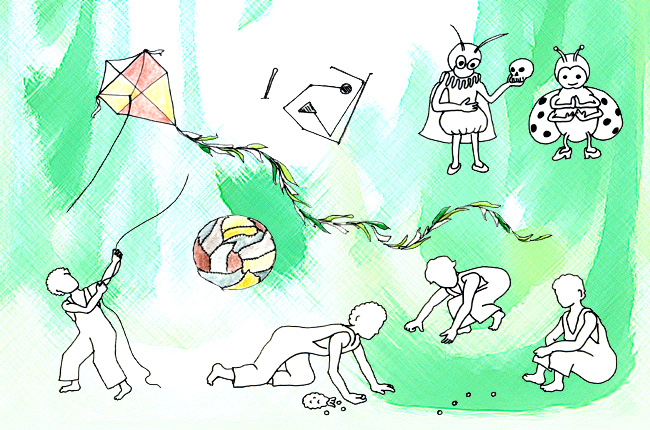
Ludado ĉiam ripetata, estis pri la putoj por la kokcineloj. Ie, en la korto, la grundo estis argileca. Mi ne scias, kiu miraklo aperigis en la korto malgrandajn vitrajn rompitaĵojn. Ni gardis ilin per grandega zorgo. Ili estis altvaloraj posedaĵoj. Kiam ni trovadis la vitropeceton, ni iris al serĉo de kokcineloj. Ili estis brunruĝaj, duonglobformaj, kun rondaj nigraj makuletoj. Estis ankaŭ kelkaj longetaj, verdaj kun ruĝaj makuloj,  sed tiuj estis tro ruzaj, facile eskapis. Post la preno de la insekto, ni arestis ĝin en alumetskatolo, alia raraĵo. Kaj ni komencis la faron de la puto, ronda trueto engrunde. Post kiam la puto estis glata, ni enmetis la kokcinelon kaj fermis per la vitra rompitaĵo. Dum la fermo, ĝi iĝis netravidebla, sed ni, per kraĉaĵo, briligis ĝin denove.
La insekto iris kaj venis kaj ni gvatadis ĝin en tiu duonmallumo.
Kurioze ke, neniam, mi trovis la kokcinelon la postan tagon. Aŭ la puteto aperis sen la vitraĵo aŭ tute malaperis aŭ nenio sanĝis escepte ke la insekto ne plu estis.
Ni ankaŭ kolektadis grilojn. Nigretajn, malgrandajn. Iu diris iam ke, se ni enterigus la kapeton de grilo, post kelkaj tagoj, ĝi iĝus kranieto. Ni senkapigis la kompatindulon, brutale forprenante la kapon, per la fingroj. La korpo estis forĵetata kaj la kapeto, enterigita. Neniam, ankaŭ ĉi tie, mi sukcesis alveni al la fino de la eksperimento. Ni perdadis la tombeton, ni forgesadis serĉi ĝin, mi ne scias.
Kelkoje ni ludadis futbalon. La pilkoj estis rezulto de pacienca manifestiĝo de primitiva artfaritaĵo. Unue necesis trovi ĉifonojn. La fadenoj devenis el la uniformoj. La kudriloj, el la sentaskaj posttagmezoj. Post la faro de buleto per senutilaj ĉifonoj, oni ekkudris pecojn je pli forta tuketoj ĉirkaŭe. Okazis do sinsekva kudrado de pecetoj kaj la pilko iĝadis, iom post iom, pli granda. Kelkfoje, tuka buleto por sferigi en ia kava parto. Post kelka tempo, ĝi aperis preta, ronda kaj peza. Kompreneble, tiu tasko ĉiam estis plenumata de grandulo.
Kelkuloj havis tenispilkon kaj pala ardeo, la plej pala ej ĉiuj, rakontas al mi pri grandaj pilkoj, kaŭĉukaj. Vere, mi sukcesas vidi ilin, tre malproksime, ludante per pilko, kiu aspektas pli granda ol tiu nia.
Iam, antaŭ la golejo, sin instalis tia tohuvabohuo, tiom da homoj ĉirkaŭ la pilko, ke ĝi restis preskaŭ senmova en malgranda spaco inter dekoj da ŝotantaj piedoj. La pilko minacis iri tien, kaj piedo relokis ĝin, alia ŝanĝetis ĝian direkton, ni ĉiuj ekridegadis, sencele ŝotante, la kompatinda pilko iĝis sendecida, tretata, ŝotata, ĝis kiam la korpoj ekperdadis la ekvilibron kaj ŝvita piramido formiĝis de korpoj aflikte ridegante kaj neniu plu sukcesis spiri…
La Homeraj dioj spertis pri homeraj ridegadoj. Sed neniam ili ridis tiun nian ridadon.
Kia avantaĝo? Sufiĉis, ke iu ajn petu partoprenon en la matĉo kaj la regularo perdis sian religian severecon kaj tuj venis alia kaj alia kaj kiom da tion volus. Kutime okazis tiuj pelmeloj, la ĵus rakontata estis la plej superba.
Ni ankaŭ iradis al la futbalkampo de la urbo. Okazis konkuroj inter la loĝantoj de la regiono. Ĉu eble kelkaj el niaj lernantoj partoprenis? Kiel mi povas scii? Ili ludadis, la plej aĝaj lernantoj spektadis kaj ni, la fantometoj, kuradis serĉe de lokustoj kaj griloj. La alumetskatoloj revenos plenplenaj kaj kiam ni malfermos ilin, en la internulejo, ni ekrigardos ke ĉiuj mortis, sed tio absolute ne estis nia deziro.
Dum unu el tiuj promenadoj, okazis fakto kiu tre impresis min. Bilardo raportadis la matĉon, bravaĵo kiu postulis tro da sperto. Li senhalte kriadis, plenentuziasme, feliĉe sin montrante. Ni ĉiuj haltis por aŭdi lin. Kaj jen li petis al iu grandulo por daŭrigi. La junulo ekis, la vortoj mankadis, li balbutis, stumblis, Bilardo riproĉis, necesas vibri, ekzaltiĝi, estis tute senviva. Kaj li prenis la vorton, raportante laŭte, rapide, plenbrile.
Mi neniam forgesis pri mia tristeco en tiu momento. Venis al mi la klarega impreso pri tio, ke por ion bone fari, necesas absoluta libero.
La granduloj havis aliajn ludojn. Ili ludadis per fera pikilo, vitraj globetoj kaj kajto.
Por ludo per pikilo, oni bezonis pikilon kaj tio estis raraĵo, eble pro tio, ke ĝi estis speco de danĝera armilo. Ili glatigis la argilecan grundon (tiu ludado nepre okazis postpluve) kaj ĉiu ludanto faris desegnaĵon. Estis la “domoj”. La unua ĵetis surgrunden la pikilon. Ĝi devis starante fali. De la domo ĝis la punkto de la falo, la ludanto faris rektan linion. Kaj li daŭrigis. La celo estis fermi per sia linio la domon de la aliulo. Se li eraris, la dua komencadis. Du spiraloj aperadis, iom post iom, ĉirkaŭ la du domoj. La venkanto estis tiu, kiu sukcesis ĉirkaŭvolvi la malamikon kaj trafi sur la propran linion, fermante la teritorion.
Ĉiuj vitraj globetoj finiĝis por aparteni al malgranda grupo de ĉampionoj, kiuj nur ludadis se la ludo estis “vera”, nome, la perdanto devus fordoni la globetojn. Mi ĉiam admiris la trafkapablon de tiuj duondioj. Ili estis la “mirokululoj”. Mi, krom tio ke mi eĉ ne kapablis korekte teni la globeton ene de la fingroj, mi neniam trafis. Mi estis “fingrulaĉo”. Mi ne bone memoras la regularon. Unu ludado havis surgrunde desegnitan arkon, sur kiu restis kelkaj trafotaj globetoj. Alia, havis tri truetojn, necesis enirigi la globeton en unu post la alia, kaj intertempe, trafi iun. La lasta havis nur etan truon surgrunde, mi absolute ne scias pri reguloj. La nomo de tiu ludado estis “anuseto”.
La kajtoj estis privilegioj por malmultaj. Eternaj sanktuloj! El kie la fadenoj, la paperoj, la bambustangetoj, la raz-klingoj, la gluiloj? La privilegiulo pasigis horojn, preparante la bambustangetojn. Poste venis la armaĵo. Kelkaj rafinuloj luksege uzis du kolorojn. Post la muntado de la kajto ili etendadis la fadenon laŭlonge de la korto, pulvorigis vitrajn rompitaĵojn, miksadis tiun pulvoron al gluilo kaj frotis la miksaĵon sur la tuta fadeno. La celo estis klopodi por froti tiun fadenon sur fadeno de alia kajto, dum kajta batalo, por ĝin rompi kaj forflugigi la kajton, perditan en la ĉielo. La vosto de la kajto estis ĉifonaro ligita al ŝnuro. Raz-klingo estis ŝnurligita al la vosto de la kajto kaj tio farigis ĝin samtempe danĝera kaj memvundebla. Per la raz-klingo oni sukcesis, pli facile, tondi la fadenon de la malamiko. Aliflanke, oni bezonis esti pli lerta por ke la raz-klingo ne tondu la fadenon de la propran kajton.
La suprenlevado de la kajto estis rito. Se alia kajto estus supre kaj, precipe, se ĝi apartenus al knabo “de ekstere”, estis vera festo. Nia heroo iom post iom liberigadis la fadenon, li sciis kiel rapidege rebobeni la fadenon ĉirkaŭ bastoneto, li dancigis la kajton per movegon de la brako, li igis la kajton vertikale plonĝi enaere, li liberigis pli da fadenon…
Sur tre blua bluaĵo ŝvebadis koloran papereton. Ĝi majeste glisadis, kvazaŭ atentema anĝelo super la Sodoma loĝantaro. Ĝi gardadis. Estis troege bele.
Neniu pastro kapablus igi pli malgranda tiun feliĉon.

daŭrigo en la venonta dimanĉo.
herons and scavengers… 13

ladybugs...

13. Ladybugs, entertainment and rays of light never erased

Translated by Angela Telles-Vaz

The writer Dalton Trevisan, in his short story, The Spy, writes that those girls never smiled. A lie! I think it’s a lie! The child’s soul is not a rope stretched forever. There must be, here and there, far from the correction paddle and soon after meals, ephemeral moments when the song goes high, the smile burst and the toy amuses.
Because, if I remember those lost days, I see that the pale herons of the soft memories are the ones that float in the empty blue. Not the claws, nor the poisoned beak of priests, correction paddles and bed wetter. The toys are, in a greater length, what handcuff my soul to my memories. And we smiled. In those plains, between the abyss of one terror and another, we smiled. We had many long moments of peace. And those moments, now, excite me like live sand of an enchanted wood. The sand rises and becomes alive. Between one moment now and one later on, we were happy. There’s no reason to lie. I was happy.
There they come quietly, my little white dwindling ghosts, asking us to recommence our mirth. I am myself unable to play. They, the ghosts live inside of me. Nevertheless, the ghost that should be me, that boy dissolved in an almost mist of a forgotten of time, always with a sad gaze and the face always looking to the floor, I feel that that boy, I feel that that little boy has died forever. His sin was to be chained completely to me and he gave way to a man that destroyed him. Today, the most he can do is to dictate me, from afar, the things that he lived there, the way he lived them.
As for the others, they stopped growing inside of me. They are forever small, forever boys. If I met them today, they wouldn’t be my friends anymore. They would also be adults that killed my little friends. We would, those of today and yesterday, be separated by a wall: on one side, what they are now and on the other, the little people I met at the orphanage.
This wall has cracks. Yes, the wall has cracks and today we can observe them while playing on the other side. They don’t realize that we the adults of today can still watch them. They didn’t live for our today but in their own moment.

A game that was always repeated at short intervals was the one with the caves for the ladybugs. Somewhere in the courtyard, the ground was muddy. I don’t know by what kind of miracle colored glass shards turned up in the courtyard. We would keep them with an enormous care. They were valuable assets. When we could get a little shard we washed it up to full transparency and ran in search of ladybugs. They were of a brownish red, round and painted black. There were also the little long ones, green, yellow, but those were very suspicious and fled easily. When the prey was caught, we closed the poor thing inside a match box, another miracle. Then, we started the construction of the cave, a tiny hole in the clay. After the clay was well smoothed we put the ladybug inside it and covered with the shard. While closing, the glass would get blurred but by spitting we turned it sparkling again.
The insect walked back and forth and we watched it in that almost darkness.
The funny thing is that I never found the ladybug on the next day. Either the cave lost its glass, completely disappeared, or looked exactly the same but was empty.
We also caught crickets. They were black and tiny. Someone once said that if we buried the head of a cricket, some days later it would turn into a skull. We would use our fingers to roughly take the head of the poor thing off. The body was thrown away and the head buried. I never made it through the experiment. We would loose where the gravesite was, forget to look for it, whatever.
Sometimes we played ball. The balls were a result of a patient expression of primitive craftsmanship. First, rags of cloths were obtained. The threads came from the overalls. The empty afternoons gave us the needles. Later, a small ball was made from the worthless rags by sewing the small pieces of toughest cloth around it. It was a succession of sewing the small pieces of cloth and the ball would get fatter. Here and there, additional cloth was used to fix the sphere flaws. With little, the ball was finished, round and heavy. Of course this task was done by one of the older boys.
Some of the boys had a tennis ball and a heron, paler than all the others, tells me about larger balls made of rubber. Indeed I can see them over there, playing with a ball that seems much larger than ours.
Once, during a soccer game, uproar happened in front of the goal area, so many people gathered around the ball that remained almost frozen, in the small space between dozens of feet that kicked themselves. The ball threatened to go to one side, a foot sent it back, another changed its direction, we all began to laugh aloud kicking aimlessly at the same time, the poor ball in a total indecision, bruised, kicked, until the bodies started to become unbalanced forming a pyramid of sweat and bodies in distress kept laughing and no one could breath anymore…
The gods of Homer were expert in the Homeric laughter. But they never laughed that laughter of ours.
But to what advantage? It was enough to ask any one to enter in the middle of the match and the rules lost its sacredness and there came one and another and as many more that wished to come. There were lots of uproars like that but that was the most significant one.
We also used to go to the soccer field in town. There were tournaments among the inhabitants of the region. Did some of us participate? What do I know? They played, the older students watched and we the little ghosts ran after the locusts and crickets. The little boxes would come back packed with them and after opening the boxes on our return, we came across a handful of little dead bugs. But we didn’t want them to die!
During one of those outings, there was a fact that struck me a lot. Sinuca was narrating the game, an achievement that required high efficiency. He kept screaming, excited, happily showing off. Everyone stopped to hear him. Then, he asked an older one to continue. The young man began, the words didn’t come out, he stuttered, stumbled, Sinuca rebuked him, it was necessary to shout, warm up, he was lifeless. And then, he gave a demonstration of a narration, loud, quick and contagious.
I never forgot how I was sad at that moment. I had the distinct impression that, in order to do something, it was absolutely necessary to be free.
The older boys had other types of toys. They played with a coarse knife, marbles and flying kites.
To be able to play with a coarse knife, it was necessary to have one, which was a rarity, perhaps because they can turn into a dangerous weapon. The clay ground was well smoothed (this game always happened after it rained), a drawing was done for each player. They were the “houses” of each one. The first person threw the course knife which should stick standing on the ground. A straight line was drawn from the house to the point where the course knife fell. And he would continue. The goal was to engage and close the enemy’s house. Missing the fall, another one began. Two spirals were made around the two houses. The winner was the one who involved the enemy by hitting his own line closing his territory.
All the marbles ended up belonging to a restricted number of experts. They were only interested in playing for real. I was always amazed by the aim of those semi-gods. They were called “aimers”. I didn’t know how to hold the marble, never guessed right. I was the “fingerstall”. I don’t remember all the rules. One of the games was played with an arch with the marbles to be hit. Another game had three holes, it was necessary to go into each hole and after that hit someone. The last game only had a small hole on the ground and I really don’t remember the rules. The name of this last one was “little ass”.
The kites were a privilege of few. Eternal Saints! Where did those lines, those papers, those sticks, those razor blades, that glue came from? The privileged worked hours with the bamboo sticks. Then, they did the frame. Some, more sophisticated, had the luxury of using two colors. After assembling the kite, which I insisted on calling parrot, they stretched the strings along the courtyard and began to grind the glass. Ground glass was mixed with glue and spread along the strings. The goal was to cut the enemy’s string during a cross over between kites so that it would disappear from the sky. The tail was made with strips of rags. A razor blade was tied to the tail of the kite what made it, at the same time, very dangerous and very vulnerable. The kite would easily cut the enemy’s string. On the other hand, this required great expertise because it could cut its own string.
Launching the kite was a ritual. If a kite was up high and especially, if it belonged to an “outsider”, it was considered a real treat. Our hero had to loosen the string little by little, with incredible dexterity to wind the string round a piece of stick, pulling the string, nose down, pulling more string…
A small piece of colored paper hung against a blue, very blue. Floating like a majestic angel observing the people of Sodom, keeping the vigil. It was extremely pretty.
No priest would be sufficient to diminish that joy.

to be continued on next sunday.

herons and scavengers… 12

du inspektoroj kaj unu pastro

12. Two supervisors and a priest

Translated by Angela Telles-Vaz

Some characters must be brought into play in this tapestry that resembles almost like lacework. It seems the threads look loosen up without them. Or it’s as if from now on, I insert needles to make big stitches, to tack the gaps and patch the holes. Although they are active and important needles, they are also threads, stitches, nodes and bows that tight to give form to increase the fabric texture.
Or bows that are tight.
If I think now about the supervisors and the priest as puppeteers that owned our unarmed will, in order to relieve them, I try to imagine them as puppets moved by superior hands. In this case, puffy hands of an old, huge and ugly whore, like some bitches of Fellini, this huge and dirty slut they call human society.
I was never able to solve the mystery I had inside of me about the supervisors. They were two. Right. Antonio and Sinuca. I have vivid memories in which both of them participated. Always separately, except during the time of the purging. The mystery rooted inside is: which one came first, which one came later? I think, at the beginning it was Antonio and then Sinuca. But I do get mixed up trying to remember what happened in the end, a little before departure, when I realize that it’s Antonio who is there again. For instance, the Nights of Paddles. It’s very likely that they both worked together, taking turns.
I don’t know if this is the case. I don’t know if this is the point. Everything is very blurred, very hazy and very white. Would it be worth to try to interpreter it all?
Well, well, well…
It was Antonio who accompanied us on our way. He was on the train together with Aluísio. Antonio was a huge and very strong mulatto. He had short, kinky hair. He was hated by everyone but if I try to remember of one only moment that I felt any negative feelings towards him, I can’t. Of course I felt the general feeling, the feeling of a deer being delivered to the lions, but not the silent hatred feeling of all the other boys, the silent rebellion of all the students.
In fact, my feelings were dubious, like a child and his father. He liked me very much, protected me openly as all the big boys did. So, I liked him but also feared him. The conflict should be worse for all the others. They were hardly beaten and yet he showed many times an extremely nice attitude. There was, for instance, a lot of camaraderie in the old boy’s dorm. He slept in the lower bunk bed and they talked up until late. I wonder though, did he actually sleep there? Or just stayed up talking until falling asleep? I remember his conversations, telling ghost stories. Another thing: did he have sheets? a blanket?  Because at the end, when the mattresses became thin and full of holes and were used as covers, even the older ones didn’t have covers themselves. Geraldo and I needed to sleep on the same side of the bed, curled up tight in order to pull the bottom of the mattress over our bodies. Who knows if Antonio slept in some other accommodation? Or was he himself another victim of the general misery?
I don’t know, I don’t know, I don’t know, no.
I don’t remember

Fate was cruel to Sinuca. He was the other supervisor. I think he never laid hands on me. But I don’t feel for this creature anything nice, nothing edifying, but a sentiment mixed of a caged hatred and an incapable pity. He was from the Northeastern region. Thin lips, malicious eyes, curly hair glued to the skull. Tiny and skinny like a hungry rat. Perhaps that’s why he was so aggressive. Antonio was huge. He would arrive with confidence. Sinuca would come in his shorts, swinging, balancing over his two slender hairy legs, he needed to shout louder and kick. He knew how to be nasty, I cannot think of anything less unpleasant about this person. Was it because he never gave me any attention at all? Or because he simply was regarded by all as a wild beast and consequently fear and hate from them all infected me? Perhaps it was all of it together. He was mortally hated. Some time before my departure, he was violently beaten by some of the older students. Hate had risen as pressure, anger increased and the despair angered those troubled hearts and they caught him off guard. They drove him into a dark corner and rushed themselves at him, discharging at the executioner the fury of a thousand victims, transforming each of the aggressors in attorneys of a collective rage.
I think this is the part that I restrained myself, scared, and repeated full of grief the reading of a passage from the book, The Tenement, from Aluísio de Azevedo, in which Jerônimo and some black guys beat up Firmo to death. A word never left my mind: the bloody package.
Sinuca disappeared completely and then came back as soft as a feather, smooth and nice. He was limping. He was patched as the Tortoise, the land turtle from the fable, who tried to travel to the party in heaven. The Tortoise entered inside the Vulture’s guitar and enjoyed the party. When they returned, the vulture found that out, turned the guitar over and the Tortoise fell off. That’s why he has cracks on his shell. That’s how Sinuca was, the patched one.
Trips to heaven can transform ascension into fall. This is a foolish, awkward and unnecessary remark.
Navigating among the students and the gods of the Olympus, who were the supervisors, floated some special students, with some blatant regalia. Were they the messengers between the worms and the authority?, like Mercury. Or bed waiters?, like Ganymede. I don’t know if they were many, these live purgatories, that were not only the gnashing of teeth of cold endless nights, nor achieved to be the transitory bliss of absolute power. At the top, they were used in secret, to avoid the disgrace known by all. At the bottom, they were scorned as the crow who adorned itself with the peacock feathers. It is true that I only remember one of those pitiable creatures, not a crow anymore and yet not a peacock: Aluísio. I say pitiful, for he was badly regarded among the students; for nothing more. I was too little to understand these complexities.

No more fables or mythology. I don’t want any literature over HIM. I’ll try to restrict to the scalpel of my memory. Perhaps my hand will tremble as I write. I don’t want to be cruel and yet I can’t be soft.
Next to the Orphanage lived the priest who was our Principal.
From where does such nauseate feeling come that the memory of that priest brings to the surface of the lost waters of my soul? He was the boss, the absolute master. If the correction paddle hurt, it was he who gave the order. If the food got worse, some frog or lizard must have been spewed from his mouth along with his coward orders. We all knew that he was the chief-puppeteer who held the strings that made Antonio and Sinuca’s movements. We all knew. So much so, that on the terrible Afternoon Rebellion, it was towards his home that the courageous and determined cries were blasted.
Bucket had no name. Friends don’t need a name. Neither that man had a name. He was just The Priest. For me, a kind of King-Vulture, a dark stain that came and went as he pleased. In my memory, he never walks with his feet on the ground he just comes and goes, floating like a ghost.
It seems that during my stay in his circle of hell, that poor Mephistopheles was mentioned in one of Rio’s magazines or some newspaper. I don’t know the proportion of the scandal. My grandmother used to say that he received the gifts from family members but didn’t pass them on to the students. My mother mentioned pairs of shoes, and clothes that weren’t ever seen by any of us. It was this article that caused my family’s despair and led them to commit themselves to get the money for our return.
Besides a hazed shadow in black gliding (oh! that Teutonic monk from the movie Alexander Nevsky), this creature fortunately didn’t mark my soul. I don’t remember his face, and know nothing about his eyes. It’s just a Vulture with broken wings forever pacing inside of me. It’s an inconvenient fly that comes back if I send it away.
For the flies of memory, there’s no insecticide.
Fortunately, he visited us very seldom. He could have come limping, in patches, with a wrinkle of concern, with sadness in his eyes, and yet any of these tiny human miseries could have been enough to mark the rest of my life. I would feel sorry for him and suffer with him, willing to find an excuse, pretending to forgive his major and only crime, which is, according to Spinoza, of ignorance. The person who agrees with Spinoza is led to forgive easily.
Years later, I’ll think: the guilt of human sin, Mr. Spinoza, it doesn’t derive from ignorance but from the neurotic immaturity of the human soul. Just a decent social life will enable human relationships to mature.
But I did not know Spinoza, I was seven-eight years old, a little more, a little less. My mind of today doesn’t have the right to philosophize on behalf of my previous fate. I was seven-eight years old but wasn’t Existentially incapable. If I could suffer, I could hate. The pain is gone, yes, but it didn’t turn into a zero inside of me.
I don’t give anyone the right to forgive in my name. I don’t give to whom I am today the right to act on behalf of who I was.
Today, I know that I cannot condemn him. But the boy that I was has already delivered him to damnation.
I don’t delete what I thought at that time.
Nothing, I repeat.
I’m only remembering unpleasant things that have already gone.

I wouldn’t like to see that man again.

to be continued on next sunday.