ardeoj kaj vulturoj… 01

ardeoj kaj vulturoj 01


Viro kiu vivus absolute sola, ne havus memoron; eĉ ne bezonus ĝin. (Pierre Janet)

Sinjoro Freud malpravis.
La nekonscio ne regas nin, sed, ja, la memoro.
Memoro estas speco de Imperiestrino de la Animoj. Estas ŝi, kiu decidas pri tio, kion ni porĉiame memoros kaj pri tio, kio forviŝiĝos de ene de ni, dum la restanta tempo de nia vivo. Ni povas lerni, kiel fari la memoron pli ampleksan. Ni povas, per terapio, rekuperi memoraĵojn laŭŝajne perditaj. Sed ni NE POVAS FORGESI tion, kies forgeson ne permesas la Imperiestrino de la Animoj.
Estas la terura rilato inter niaj memoraĵoj kaj tio, kion ni ne kapablas forgesi, estas tiu rilato, kiu difinas la homan estaĵon. Ni estas tiu sumo. Ĉi tie ne okazas subtraho. Forviŝaĵo signifas nur tion, kio ne apartenas al ni; tion, kio ni ne plu estas, kaj neniam plu estos.

1. Antaŭaj okazaĵoj
ardeoj kaj vulturoj 01

Resume, jen la faktoj, kiuj okazis antaŭ ol mi venis al la trajnstacio.
Ni alvenis al Rio-de-Ĵanejro, panjo, Geraldo, Amelja, mi kaj Angela. Tri tagoj ene de kamionkajuto, escepte de Geraldo, kiu vojaĝis sur la ŝarĝplato, kun servisto. La dua vojaĝtago estis datreveno de Angela, ŝi iĝis kvin jaraĝa. La dudekkvara de marto, 1949. Sekve, mi havis ses jarojn kaj preskaŭ naŭ monatojn.
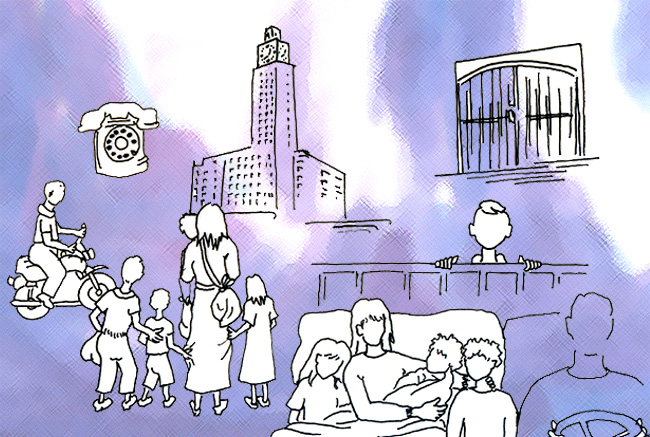
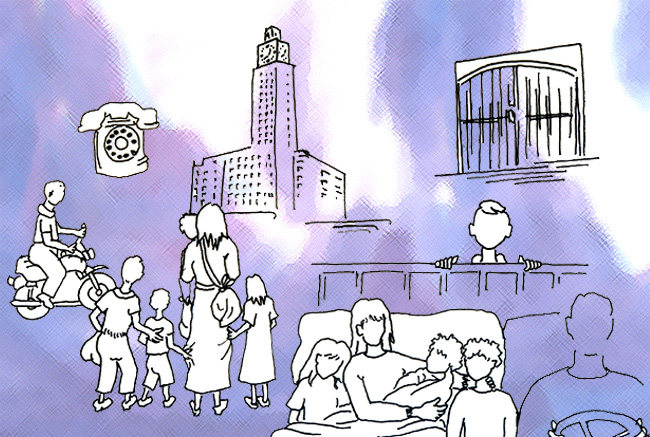
Hodiaŭ, la vojaĝo pli ŝajnas mallonga serio da fotoj. Pecoj el memoraĵoj. Aŭ malgrandaj scenoj de silenta filmo, difektita, tro hela, konfuza muntado ĉar kelkaj bildoj enmiksiĝas ene de aliaj.
La scenoj en la kamiono; tagmanĝo en restoracieto; ni ĉiuj dormas sidante surtrotuare ĉirkaŭ panjo, en malluma kaj mortinta nokto, unu apogata sur la alia, dum ŝi konversacias kun virino de la urbo.
En la Avenuo Prezidanto Vargas, motociklisto haltis kaj gestis al panjo; kaj ni, maltrankvile, transpasis la larĝegan straton. En tiu momento, mi pensis ke mi neniam plu revidos lin. Kaj, se mi  bone memoras, estas la unua fojo kiam mi tion pensis: se mi vidas aŭ sentas ion, mi konkludas ke tio neniam plu ripetiĝos.
Post la motociklisto, jen, ni jam estas en la apartamento de onklino. Telefono! La aŭtomobiletoj sub ni! Strato Washington Luis, 1, apartamento 801, telefonnumero 32-8366. Ĉu tio veras? De la fenestro, Geraldo ĵetis groŝon, ni malsupreniris kaj serĉis ĝin, vane. Mi ne scias kiom da tagoj ni tie restis.
Ĉar en la posta memorata sceno, mi rigardadas la altan pordegon de la Nacia Internulejo por Neplenaĝuloj. Iu knabo diras al mi ke tute neeblas fuĝi tra tiu pordego. Kial iu volas fuĝi?, mi pensas. Ni ĉiuj vestas bluan uniformon, la pastro instruas kanzonon, kies vortojn mi forgesis:

    Ni volas Dion, ni, maldankaj… Mokas pri fid’ la malsaĝuloj… Pri nia fid’, Maria, la plendon, nun, aŭdu vi…

Kion signifas plendo?, mi pensas. La muziko eniras en mi kaj sufokas mian animon, la komocio dolorigas min kaj la pastro fandiĝas kaj malaperas.
Certe, Geraldo estis proksime, ĉar kelkfoje li aperas, kvazaŭ magie. Lia ĉeesto komfortigas min, mi scias ke baldaŭ baldaŭ li estos dekdu jaraĝa!
Jen mi meze de kelkaj knaboj, unu el ili metas la rigidan montran fingron ĉe la vizaĝo de aliulo kaj alvokas:
Hej, bubo!
Kaj la alia, sin turnante, batas la vizaĝon sur la fingron. Ĉiuj ridas. Mi pensas ke ankaŭ mi ridis. Mi faras la samon al najbaro:
Hej, knabo!
Sed la vorto knabo ŝajnas al mi fremda kaj senefika. Knabo, tie, ne estis knabo sed bubo. Aŭ etulo. Bubo, etulo, la vortoj dancadis ene de mi.
Mi ne scias kiom da tagoj mi restis en tiu konstruaĵo. Ĉu eble ni dormis tie? Certe, jes, ĉar mi memoras pri vizitantoj, mi memoras pri pomoj kaj pri la malĝoja rigardo de panjo. Kaj, se iu demandus al mi tion, kion signifas la vorto vidvino…
…tiutempe mi konis malĝojegan infanan kanzonon:

Mi vidas ŝtonegon tre altan,
Neniu atingas ĝin.
Sur ĝi sidiĝas vidvino,
Kun granda angor’ en la sin’, en la sin’, en la sin’.

…kaj, se iu demandus al mi tion, kion signifas la vorto vidvino…
…mi dirus, ke vidvino estas tio, kio estas panjo.
Tamen, panjo ne estis vidvino. Nur ke ŝi forlasis la alkoholaman edzon kaj kondukis la idaron ale al la granda urbo.
Subite, la pordego, la pastro, la emociiga kanto, la bubaro, la vizitantoj, ĉio malaperas. Jen mi en la trajno.
Jen mi en la trajno!
Jes, mi finfine alvenis al la stacidomo. Jarojn poste, iu diros al mi ke la tago estis la sankta vendredo.

daŭrigo en la venonta dimanĉo.
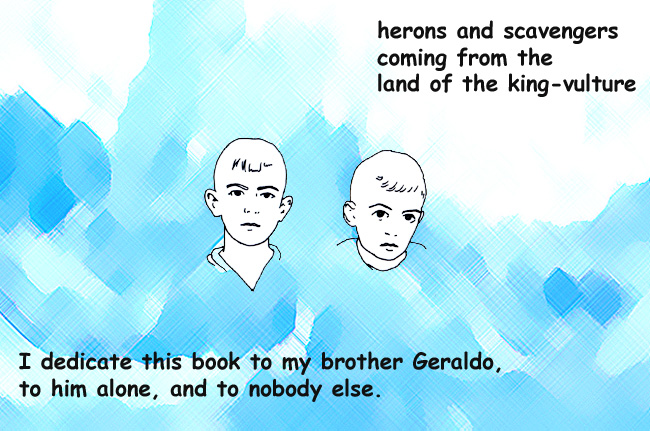
herons and scavengers… 01

herons and scavengers 00


    A man entirely alone, would not have any memory; nor need it. (Pierre Janet)

    Mr. Freud was wrong.
The unconscious has no power over us, but memory does.
Memory is like an Empress of Souls. She decides what we will remember for all times and what goes out from within us for the rest of our lives. We can learn to broaden memory. We can, in therapy, rescue memories that seemed lost. But WE CANNOT FORGET, by choice, what the Empress of Souls doesn’t allow to be forgotten.
It’s the terrible game between the memories we have, and what we cannot forget, it’s the game that defines each human being. We are this sum. Here there are no subtractions. What is erased was not ours; what we are no longer, or shall never be.

1. Background

herons and scavengers 01

Translated by Angela Telles-Vaz
Proofread by Izabel Arocha

The facts prior to my arrival at the train station follow:
We had traveled to Rio, Mom, Geraldo, Amelia, Angela and I. Three days of travel in the cabin of a truck, Geraldo at the back with the helper. On the second day in Muriaé, Angela turned five years of age. March the 24th 1949. I was therefore, six years old and nearly nine months.
The trip today is more like a short sequence of photos, pieces of memory, a short scene from a silent film, scratched, very clear, a complex assemble in which images are mixed inside each other.
The scenes of the truck, the lunch at the Inn, on her birthday; all of us sitting on the sidewalk around mother, on a dark and dead night, sleeping and leaning on each other, while she talked to a resident of the city (Leopoldina?).
At President Vargas Avenue, a man stopped the motorcycle and in distress, we crossed the broad street. I thought that I would never see him again. It was the first time that I recall having had this idea, seeing or feeling this kind of thing, I believe that a moment will not repeat itself.
After the motorcycle man, we are already at the apartment of my aunt. Telephone, little cars stand below, 1 Washington Luis Street, Apartment 801, telephone 32-8366. Was it really that? Geraldo threw a penny from the top floor and we went down to try to find it to no avail. I don’t know how many days we stayed there.
At the next scene, I’m already looking at the iron gate of MAS (Minor Assistance Services). Some boy is telling me that it would be impossible to run away through there. But why would anyone want to run away from there?, I think. I’m wearing a blue overall, like everybody, the priest teaches us a song with words I’ve already forgotten:

    We want God, ungrateful men… Faith is mocked by fools… Of our faith, Oh Virgin, Bless the call…

What would be the call?, I think. The music penetrates me and chokes my soul, the excitement hurts and the priest dissolves and disappears.
Of course Geraldo had to be there because every now and then he reappears as if by magic. His presence makes me feel safe. I know that soon he will be twelve years old!
I’m among some boys and one of them puts his stiff finger on another one’s face and says:
Hey kid!
And the boy while turning around hits his face on his finger. Everyone laughs. I think I laughed too. I do the same with a neighbor:
Boy!
But the word sounds foreign and disarmed. Embarrassed I cringed. There, boy was not called boy but kid. Or otherwise child. Child, kid, the words danced inside of me.
I don’t know how many days we were in that building. Had we slept there? Certainly we did, because I remember the visits, I remember the apples and I remember the sad look of my mother. And if someone asked me what was a widow…
… in those days, I knew a very sad children’s song:

    There’s a cliff so high
That nobody can reach.
There sat the poor widow
Who sadly began to cry,
To cry,
To cry…

…and if somebody asked me what a widow was…
…I would say that a widow was what my mother was.
But my mother was not a widow. She just left her drunken husband, carrying her offspring to the big city…
Suddenly the gate, the priest, the touching song, the kids, the visits, everything is going back. I’m on the train.
I’m on the train!
I finally arrived at the station. Years later, I would find out that it happened on a Good Friday.

      to be continued on next sunday.

o papagaio de zamenhof

O PAPAGAIO DE ZAMENHOF

    Esta pecinha foi escrita originalmente em Esperanto. Foi apresentada com atores na Associação Paranaense de Esperanto, Curitiba, no final do ano letivo de 1987 e, com bonecos, no 25o. Congresso Brasileiro de Esperanto. em Campo Grande, em julho de 1989. Como um dos personagens só fala em Esperanto, tive que fazer algumas adaptações nessa tradução.

Cena primeira:

MACACO (entrando): Brasileiros e brasileiras!
APRESENTADOR (voz): Macaco! Macaco, onde está você? (entrando) Ah, está aqui. Está fazendo o quê?
MACACO: Nada. Estava cumprimentando o público e depois vou apresentar o teatro pra todos?
APRESENTADOR: Teatro… pra todos… pra quem?
MACACO: Pra eles.
APRESENTADOR: Eles… Você não sabe que eu não enxergo direito? Quem está aqui?
MACACO: Os esperantistas?
APRESENTADOR: Mas que esperantistas?
MACACO: Estamos num Congresso… É a hora do teatro…
APRESENTADOR: E por que não me avisou antes? Imbecil! EU vou cumprimentar o público. EU apresentarei o teatro. EU receberei os aplausos. Você, imbecil, vai passar o chapéu e recolher o dinheiro. E EU guardarei o dinheiro. (fazendo pose) Boa noite, senhores. Boa noite a todos. Música, música!… Eu apresento aos senhores o grupo de teatro de bonecos mais famoso do mundo! Nossos bonecos são estrangeiros. Estudaram nas mais famosas Universidades. Já até recusaram ofertas pra filmar nos Estados Unidos. Porque preferiram fazer esta apresentação para os senhores. (os dois saem cantando)
APRESENTADOR: Me dêem o dinheiro,
            que eu conto o conto inteiro…
MACACO:        O pobre macaquinho,
            também quer um dinheirinho…

GLORIA (entrando): Boa noite. Sou a senhorita Glória. Estou visitando este país desconhecido porque sou antropóloga. Esta região onde estou me é inteiramente desconhecida. Ainda não encontrei vivalma. Estou por aqui porque procuro um presente pro meu pai, o famoso e reconhecido professor Geraldomattos. Ele mora em Curitiba e coleciona objetos exóticos. O aniversário dele será na próxima semana. E terei que mandar o presente pelo correio porque não terei tempo de chegar em casa no dia certo. Se não encontrar o presente pro meu paizinho queridão, não sei o que farei. (ouve-se um barulho estranho). Parece que vem alguém, ouvi um barulho. (entra um Sujeito estranhíssimo, meio gente, meio robô; junto dele, o Papagaio) Em que língua devo falar com ele? O Senhor fala português?… (o Sujeito olha apenas) Do you speak English?… Parlez-vous français?… Parlate italiano?… Sprechen Sie Deutsch?… Diable, li vere nenion komprenas…
SUJEITO: Tion mi komprenas, tion mi komprenas!
GLORIA: Ôpa! Eu sem querer falei em Esperanto e ele disse que me entende. Vou perguntar de novo, pra confirmar. Ĉu vi parolas Esperanton?

Continue lendo “o papagaio de zamenhof”